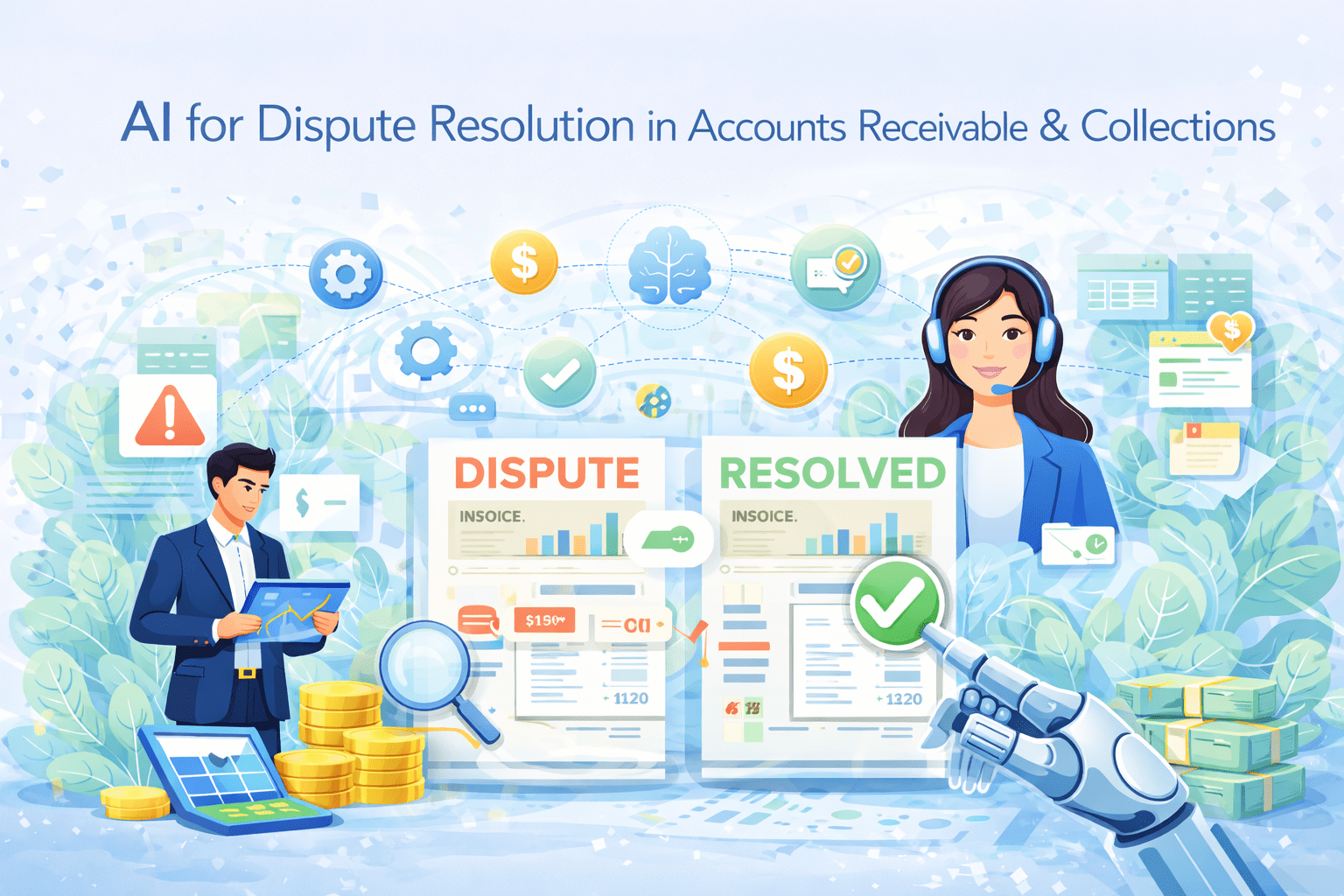

Disputes are one of the biggest hidden blockers in Accounts Receivable. Even when customers are willing to pay, unresolved disputes around pricing, quantities, contracts, or documentation can keep invoices open for weeks or months. For finance teams, this results in delayed cash flow, inflated aging, and unnecessary follow-ups.
Artificial Intelligence (AI) is changing how disputes are identified, managed, and resolved. Instead of treating disputes as manual exceptions, AI enables finance teams to detect issues earlier, route them faster, and resolve them with far less effort.
Table of Contents
Why Disputes Are So Hard to Manage in AR
Dispute management has traditionally been fragmented and reactive.
Invoices often remain open without clear visibility into why they are unpaid. Dispute details live across emails, ERP notes, spreadsheets, and ticketing systems. By the time a dispute is identified, it has already delayed cash and consumed significant manual effort.
Manual processes also make it difficult to spot patterns, measure root causes, or prevent repeat issues.
What AI Brings to Dispute Management
AI changes dispute management by adding intelligence, context, and automation to every stage of the process.
Early Dispute Detection
AI can analyze payment behavior, customer responses, and invoice patterns to identify potential disputes before they are formally raised. This allows finance teams to intervene early instead of waiting for invoices to age.
Intelligent Classification of Disputes
Once a dispute is detected, AI can automatically classify it by type, such as pricing mismatch, missing documentation, quantity variance, or contractual disagreement. This removes manual triaging and speeds up resolution.
Context-Aware Decision Support
AI pulls together relevant context such as contracts, prior invoices, customer history, and previous resolutions. This helps teams understand the dispute quickly without searching across systems.
How AI Improves the Dispute Resolution Process
AI does more than identify disputes. It actively improves how they are resolved.
Faster Routing to the Right Teams
Instead of disputes bouncing between departments, AI routes each case to the correct owner based on dispute type and past resolution patterns.
Automated Communication and Follow-Ups
AI can draft and trigger context-aware communications to customers or internal teams, ensuring timely updates and reducing back-and-forth emails.
Learning from Past Resolutions
As disputes are resolved, AI learns which actions lead to faster outcomes. Over time, this improves routing, prioritization, and recommended actions.
Common AI Use Cases in Dispute Management
AI is already being applied across multiple dispute scenarios in AR.
Invoice and Pricing Disputes
AI compares invoice data against contracts, price lists, and historical transactions to quickly identify mismatches.
Quantity and Delivery Disputes
By correlating invoices with delivery records and acknowledgments, AI helps validate claims and resolve discrepancies faster.
Documentation-Related Disputes
Missing purchase orders, delivery proofs, or approvals are flagged automatically, reducing resolution delays caused by incomplete information.
Recurring Dispute Pattern Analysis
AI identifies recurring issues by customer, product, or region, enabling finance teams to address root causes rather than individual cases.
Benefits of Using AI for Dispute Management
AI-driven dispute management delivers measurable benefits.
Faster Resolution Cycles
Early detection and automated routing significantly reduce dispute aging and invoice delays.
Improved Cash Flow
With fewer invoices stuck in dispute, collections improve and cash becomes more predictable.
Reduced Manual Effort
Finance teams spend less time tracking, emailing, and reconciling disputes, freeing up capacity for higher-value work.
Better Customer Experience
Clear, timely communication and faster resolutions strengthen customer relationships instead of straining them.
Challenges to Keep in Mind
While AI improves dispute management, it must be implemented thoughtfully.
Data Quality and Consistency
AI relies on clean invoice, contract, and payment data. Poor data quality limits effectiveness.
Explainability and Control
Finance teams need visibility into why AI makes certain recommendations, especially for audit and compliance purposes.
Integration with Existing Workflows
AI works best when embedded into existing AR and ERP workflows rather than operating as a standalone tool.
The Future of AI in Dispute Management
As AI capabilities mature, dispute management will move from reactive resolution to proactive prevention. Systems will not only resolve disputes faster but also predict which invoices are likely to be disputed and recommend preventive actions.
For finance teams, this means fewer surprises, shorter cash cycles, and a more resilient receivables operation.
How FinFloh Automates Dispute Management with AI Agents
FinFloh applies AI and agent-based automation to dispute management by embedding intelligence directly into the accounts receivable workflow. Instead of treating disputes as isolated exceptions, FinFloh enables finance teams to detect, track, and resolve disputes as part of a continuous, end-to-end process.
By combining contextual data, automation, and learning systems, FinFloh helps teams reduce dispute aging, accelerate cash recovery, and improve customer experience without increasing manual effort.
AI-Driven Dispute Detection and Classification
FinFloh automatically identifies disputed invoices by analyzing payment delays, customer responses, short payments, and historical patterns. Once detected, disputes are classified by type, such as pricing, quantity, documentation, or contract-related issues, eliminating manual triage.
Intelligent Routing and Ownership Assignment
Based on dispute type and past resolution outcomes, FinFloh routes each dispute to the appropriate internal owner, whether in finance, sales, operations, or customer success. This ensures disputes reach the right team quickly instead of circulating across departments.
Context-Aware Resolution Support
FinFloh’s AI agents surface all relevant context for each dispute, including invoices, contracts, payment history, previous resolutions, and customer communication. This reduces investigation time and enables faster, more confident decision-making.
Automated Follow-Ups and Customer Communication
FinFloh automates dispute-related communication by triggering timely, context-aware follow-ups with customers and internal teams. This keeps disputes moving forward without relying on manual reminders or email tracking.
Learning from Resolution Outcomes
As disputes are resolved, FinFloh’s AI agents learn from outcomes, identifying which actions lead to faster closure. Over time, this improves routing accuracy, prioritization, and recommended resolution steps.
By automating the full dispute lifecycle, FinFloh enables finance teams to shift from reactive firefighting to proactive dispute management, unlocking faster collections and more predictable cash flow.
You can know more about FinFloh automates Dispute Resolution using AI on this FinFloh Collaborative Communication page. You can also Book a Demo to see how the product works and Book a Free Trial to use the product.
Conclusion
Disputes no longer need to be a manual bottleneck in Accounts Receivable. With AI, finance teams can detect issues early, resolve them faster, and continuously improve how disputes are handled.
As receivables complexity grows, AI-driven dispute management is becoming an essential capability for modern finance teams focused on cash flow, efficiency, and customer trust.
