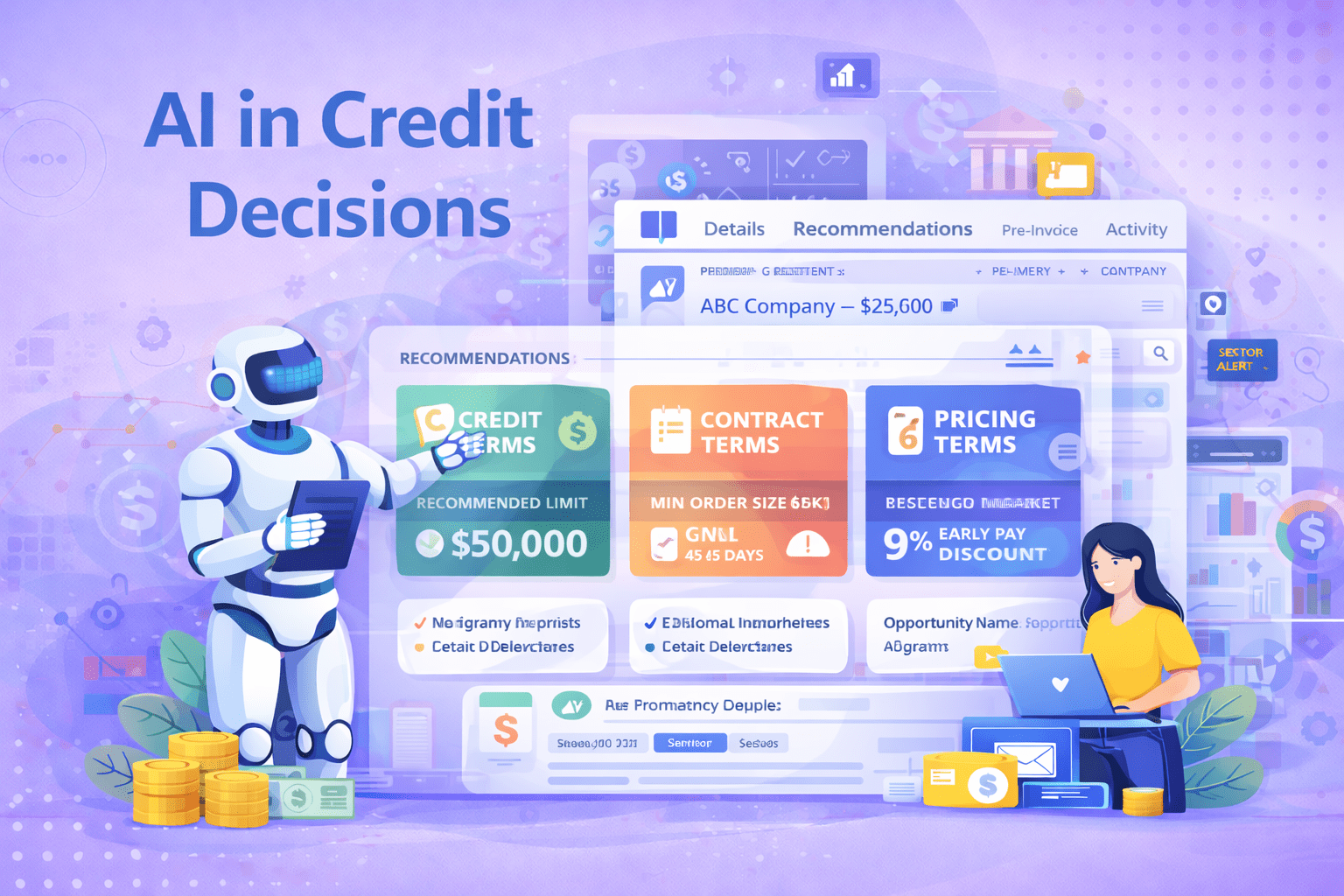

Credit scoring evaluates risk.
Credit decisions act on it.
While scoring measures probability, decisioning determines:
- Credit limits
- Payment terms
- Contract terms
- Pricing terms
- Approvals and holds
AI in credit decisions transforms these decisions from manual approvals into intelligent, policy-driven actions embedded directly into CRM workflows.
Table of Contents
What Is AI in Credit Decisioning?
AI in credit decisioning uses predictive risk models, workflow automation, and real-time data to recommend or execute credit actions automatically.
Instead of waiting for manual approvals, AI supports or automates decisions such as:
- Approving new customers
- Adjusting credit limits
- Customizing payment, pricing, or contract terms
- Triggering holds or structured onboarding paths
This ensures consistency, agility, and governance across your credit function.

Challenges in Traditional Credit Decision Processes
Many organizations still depend on:
- Manual spreadsheet-driven approvals
- Email-based review chains
- Static annual credit policies
- Siloed credit and sales processes
These limitations lead to:
- Slow customer onboarding
- Inconsistent credit offers
- Delayed revenue realization
- Higher exposure risk
AI resolves these by embedding intelligence into every credit decision.
How AI Improves Credit Decisions
Dynamic Credit Limit Management
AI continuously evaluates:
- Real-time payment behavior
- Outstanding exposure
- Risk score shifts
- Order growth trends
- Industry and macro signals
This enables credit limits to evolve with actual customer risk.
Contract Term Recommendations
Instead of generic contract terms, AI can analyze:
- Customer risk profile
- Historical payment behavior
- Order patterns
- Market risk signals
…and recommend contract terms such as:
- Minimum order sizes
- Escalation clauses
- Credit buffers
- Prepayment requirements
This aligns contract structure with real risk — minimizing exposure.
Pricing Term Recommendations
AI can also recommend pricing adjustments based on risk signals and buyer behavior, including:
- Early payment discounts
- Risk-adjusted pricing tiers
- Revenue-linked contracts
- Incentives for on-time payment
These dynamic pricing terms help sales teams strike deals quicker without sacrificing financial discipline.
Policy-Driven Automation
AI integrates with rule engines to enforce:
- Risk thresholds
- Exposure caps
- Approval hierarchies
- Escalation logic
Low-risk decisions can be auto-approved, and high-risk cases route for expert review.
Early Warning Triggers
When risk signals change — such as deteriorating payment trends — AI can:
- Recommend credit limit reductions
- Suggest revised payment terms
- Flag accounts for review
- Automatically update contract or pricing guidance
Measurable Business Outcomes
Organizations that apply AI in credit decisions benefit from:
- Faster sales onboarding
- Lower bad debt
- Higher revenue capture
- Consistent credit risk governance
- Better compliance and audit trails
Credit decisions become both faster and more disciplined.
Why AI in Credit Decisions Matters Today
In an environment of economic uncertainty and fast-moving markets:
- Exposure can change quickly
- Manual reviews don’t scale
- CRM and sales productivity suffer
AI ensures decisions align with risk appetite and business goals in real time.
How FinFloh Implements AI in Credit Decisions
FinFloh’s AI-powered credit decisioning engine is embedded directly in CRM environments like Salesforce, enabling real-time credit, contract, and pricing recommendations exactly where deals are managed.
Real-Time, CRM-Embedded Decisioning
FinFloh analyzes buyer behavior, payment history, credit scores, and live risk signals to generate credit, contract, and pricing term recommendations at the opportunity stage — before a deal closes. This removes latency from traditional finance review cycles.
This means:
- Sales receive recommended credit limits
- Suggested payment terms (e.g., Net 30, early pay discount windows)
- Contract term guidelines
- Pricing term adjustments tied to risk and revenue objectives
All without switching applications.
Integrated Market Intelligence
FinFloh enriches decisioning with external signals such as:
- Industry risk trends
- Order volatility
- Macroeconomic indicators
This ensures that credit decisions reflect both customer data and market context — a major advantage in volatile markets.
Automated Onboarding & Rapid Approvals
By connecting to CRM workflows, FinFloh can:
- Accelerate onboarding of new accounts
- Auto-recommend credit and contract packages
- Trigger alerts for finance review
- Reduce reliance on manual spreadsheets and email approvals
This leads to faster sales cycles and lower friction between credit and sales.
To implement FinFloh’s AI Engine for Credit Decisions, you can check out FinFloh Credit Decisions product page. You can also Book a Demo to see how the product works or you can Book a Free Trial for a first-hand experience of the product.
Conclusion
AI in credit decisions is more than just automation.
It is about aligning risk, contract, pricing, and revenue objectives in real time.
Powered by Machine Learning, CRM integration, and market intelligence, AI ensures the right customers receive the right terms — accelerating growth without compromising financial stability.
