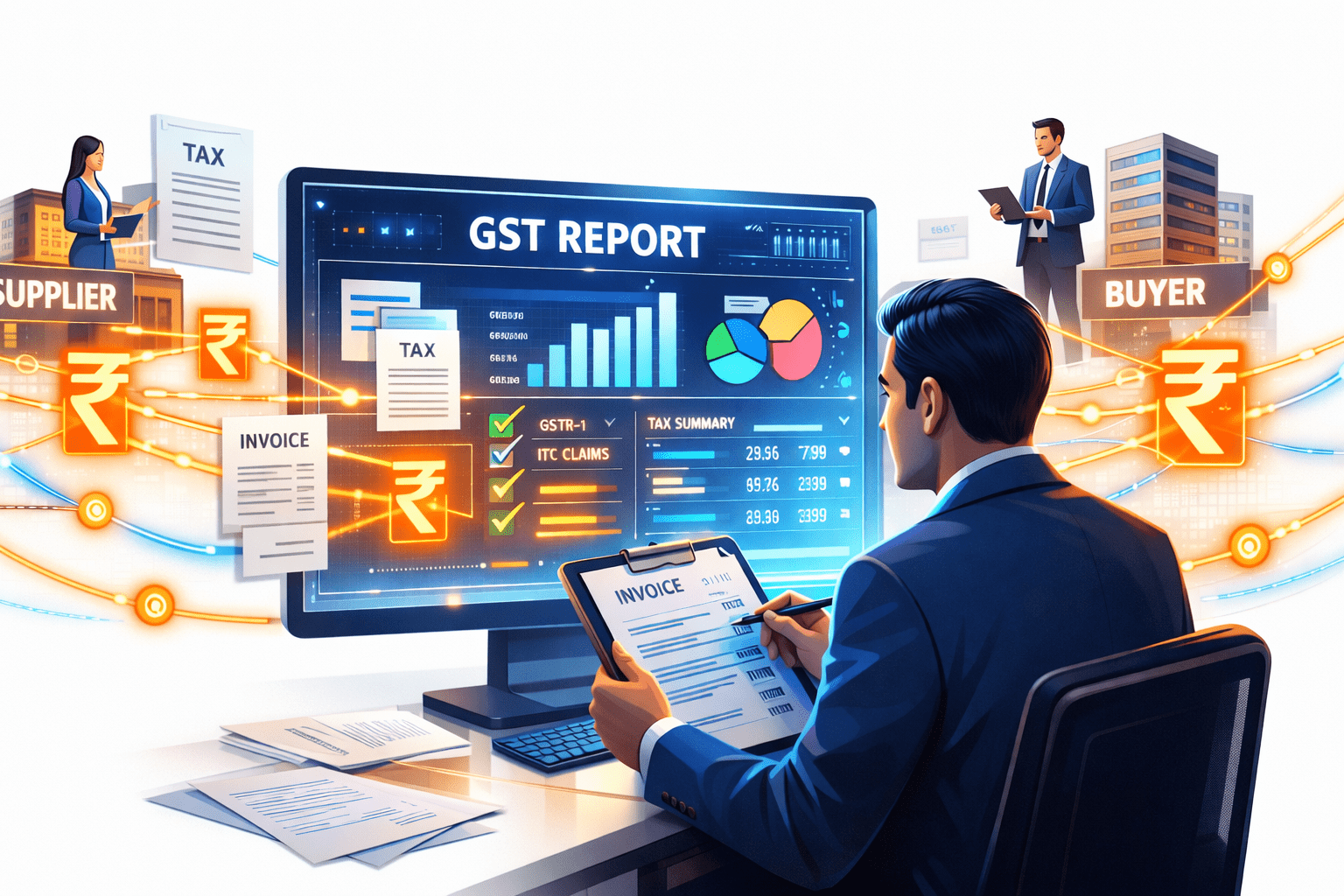

For many businesses, B2B taxes in India – GST is both a compliance necessity and a strategic opportunity. Since its introduction, GST has changed how Indian companies handle tax, reconciliation, and invoice management. But even years after implementation, navigating the complexities of tax filing, credit reconciliation, and vendor compliance continues to challenge finance teams.
At FinFloh, we’ve seen how businesses struggle with missed input credits, mismatched invoices, and delayed filings — all of which affect cash flow and create compliance risks. This blog aims to simplify GST for B2B businesses and highlight how automation can make your tax and finance operations far more efficient.
Table of Contents
What Is GST and Why It Matters in B2B Transactions?
Introduced in 2017, the Goods and Services Tax (GST) consolidated India’s multi-layered indirect tax structure into a single, unified system. Instead of juggling multiple taxes like VAT, Excise, and Service Tax, businesses now pay one tax—GST—on goods and services.
For B2B companies, GST plays a crucial role because every transaction has two sides—what you sell and what you buy. Both are interlinked through Input Tax Credit (ITC). A single mismatch between invoices or late filing by a vendor can cause credit losses or compliance issues. That’s why understanding GST in B2B operations isn’t just about accounting—it’s about building financial agility.
Core Components of B2B GST Compliance
1. Input Tax Credit (ITC) and Why It’s Critical?
The ability to claim input credit is the foundation of GST. Businesses can claim the tax paid on purchases as a credit against the tax collected on sales—provided suppliers have filed their returns correctly.
However, manual tracking often leads to discrepancies between GSTR-2B and purchase records, blocking working capital. Automated reconciliation tools help match invoices in real time, identify mismatches, and prevent loss of credits that could impact cash flow.
2. E-Invoicing and Real-Time Validation
E-invoicing is now mandatory for most medium and large enterprises. Each invoice must be validated through the Goods and Services Tax Network (GSTN) to generate an IRN (Invoice Reference Number).
Automation ensures every invoice is correctly formatted, validated, and uploaded without manual intervention—saving time and ensuring compliance from the start.
3. Reverse Charge Mechanism (RCM)
Under RCM, the buyer (recipient of goods or services) is responsible for paying GST instead of the supplier. This mechanism applies to certain categories such as legal services or imported goods.
Finance teams must identify RCM-eligible transactions early to avoid non-compliance or late payment penalties.
4. GSTR Filing and Reconciliation
Filing GSTR-1, GSTR-2B, and GSTR-3B accurately and on time is essential. Delayed or incorrect filings can lead to penalties and loss of ITC. Automation simplifies this process by syncing invoices, tax data, and payment records into one platform, ensuring real-time reconciliation and audit readiness.
The Real Impact of GST on Accounts Receivable (AR)
For AR teams, B2B taxes in India – GST isn’t just another compliance layer—it directly affects how fast the company gets paid. Inaccurate tax amounts, credit notes, or delayed filings often lead to disputes and delayed collections.
Automating AR processes with GST logic built in helps teams:
- Reconcile invoices instantly against GSTN data
- Match payments and credits accurately
- Automatically generate compliant credit notes
- Detect mismatches between GSTR-1 and customer filings
- Maintain clean, audit-ready records
The result? Faster collections, reduced disputes, and better DSO (Days Sales Outstanding).
How Automation Simplifies GST Workflows?
When GST was introduced, many businesses relied on spreadsheets and manual uploads. Today, that approach simply can’t keep up with transaction volumes and frequent regulatory updates.
Here’s where automation transforms the landscape:
- End-to-End Invoice Management: Create, validate, and share GST-compliant invoices automatically.
- Real-Time Tax Reconciliation: Identify mismatches between your books and GSTN instantly.
- Seamless Credit Management: Claim every eligible Input Tax Credit with confidence.
- Integrated Reporting: Generate returns, summaries, and audit reports without manual effort.
Automation reduces dependence on last-minute data cleanups and manual corrections—allowing finance teams to focus on strategy rather than compliance firefighting.
Common GST Challenges Faced by B2B Companies
Even with years of GST adoption, challenges persist:
- Invoice Mismatches: Suppliers delay uploading invoices, causing credit lockups.
- Complex Reconciliations: GSTR-2B vs. internal purchase register mismatches create confusion.
- Frequent Rule Updates: Changing thresholds and notifications demand constant vigilance.
- Data Silos: AR, AP, and tax data stored in different systems lead to inconsistencies.
The good news? Automation platforms unify these workflows—creating a single source of truth for tax, payments, and receivables.
The Future of B2B Tax Compliance in India
India’s GST regime continues to evolve—with tighter reporting norms, real-time data validation, and e-invoicing expansion for smaller businesses on the horizon.
Finance teams that invest in automation now will be better equipped to adapt quickly, stay compliant, and maintain cash flow stability.
Moreover, with emerging integrations between ERP, bank, and GSTN systems, the future of B2B taxes in India – GST will revolve around seamless data exchange and predictive compliance—where issues are detected before they occur.
Conclusion: Make GST Work for You, Not Against You
Understanding B2B taxes in India – GST doesn’t have to be overwhelming. By automating your tax-linked receivable and payable processes, you can turn compliance into an advantage—saving time, improving accuracy, and freeing up capital.
At FinFloh, we help businesses modernize their finance stack, automate collections, and simplify GST-linked workflows. The result: complete visibility, compliance confidence, and faster financial decisions.
Let our experts show you how FinFloh can automate your GST-linked AR workflows—so your finance team can focus on growth, not paperwork.
