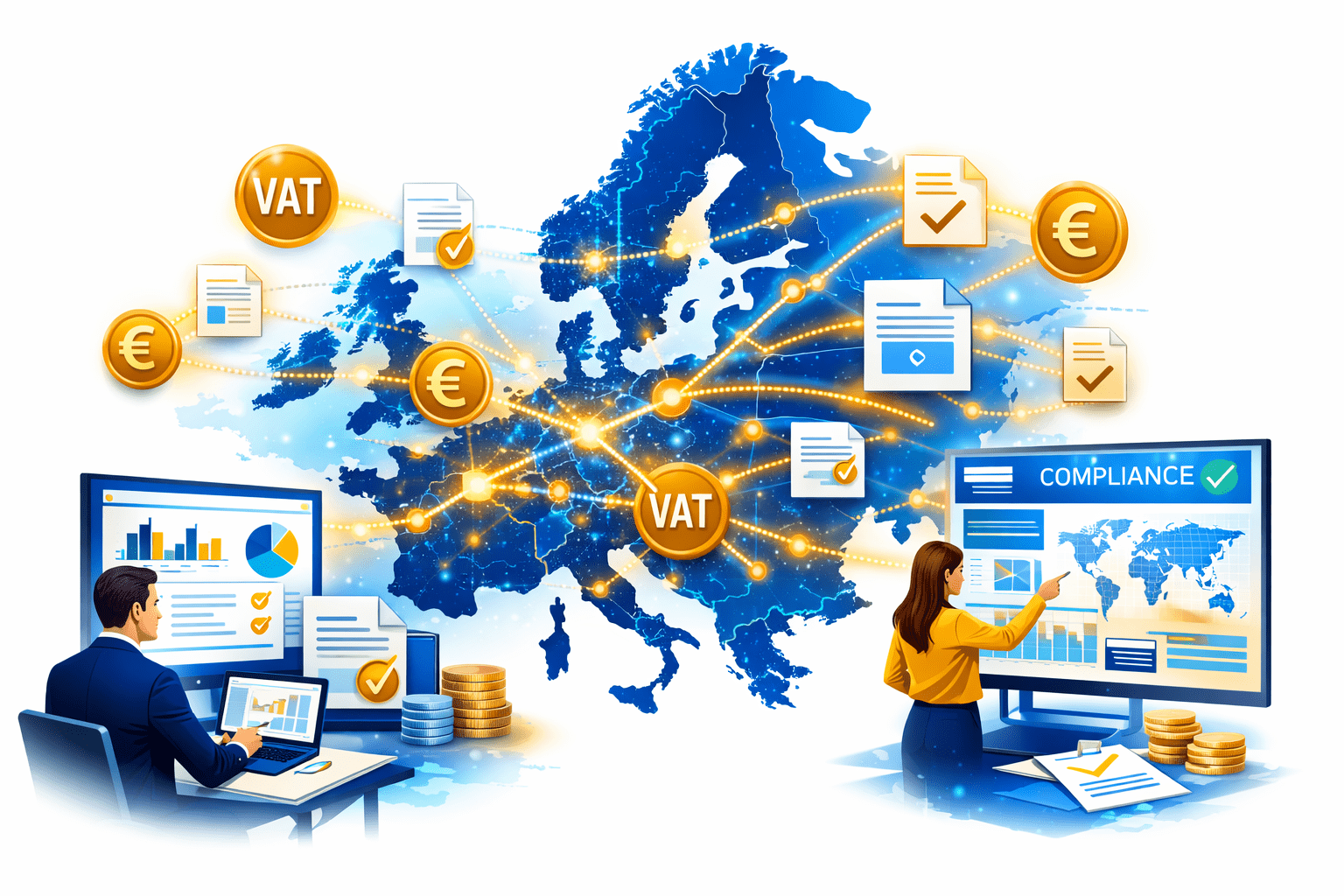

Doing business across European borders opens exciting opportunities — but it also brings tax complexities that can make even the most experienced finance professionals pause. Understanding B2B taxes in Europe is essential for staying compliant, managing cross-border invoices, and ensuring financial accuracy.
Between varying Value Added Tax (VAT) rules, frequent policy updates, and intricate reporting standards, navigating the European tax landscape can feel overwhelming. This guide simplifies it all — helping you understand how B2B taxes work, where businesses struggle, and how automation can make compliance effortless.
In this blog, we break down what B2B taxes mean, the major challenges businesses face, and how automation can simplify compliance and reporting for finance teams.
Table of Contents
What Are B2B Taxes in Europe?
At the heart of European taxation lies VAT (Value Added Tax) — a consumption tax applied to goods and services. While the framework is EU-wide, each member state has its own tax rates and interpretations, making things complicated for cross-border trade.
For B2B transactions, the rules depend on whether the trade happens within the same country, across EU borders, or outside the EU:
- Domestic transactions: VAT is applied based on the local rate.
- Intra-EU trade: Usually zero-rated if both supplier and buyer have valid VAT numbers.
- Extra-EU trade: Considered exports/imports and may require proof of shipment or customs documentation.
In simple terms, businesses act as tax collectors — charging and remitting VAT to the appropriate tax authority.
Why Are B2B Taxes So Complex in Europe?
Even though there’s an EU framework, each country applies it differently. That’s where the confusion begins.
Here are a few key factors that make B2B taxation tricky:
1. Cross-Border Complexity
A single invoice to a customer in another EU country might follow different tax logic than one issued locally. Tracking rates and exemptions across regions becomes tedious.
2. Frequent Policy Changes
The European Commission regularly revises VAT frameworks — like the One Stop Shop (OSS) — leaving finance teams constantly catching up.
3. Manual Processes & Errors
When invoice processing, tax validation, and reconciliation are done manually, errors creep in — leading to non-compliance or delayed reporting.
4. Lack of Real-Time Visibility
Without a unified system, tracking tax data across different ERPs or spreadsheets becomes a blind spot for many businesses.
How Automation Simplifies B2B Tax Compliance
Automation isn’t just a convenience anymore — it’s becoming a necessity. Here’s how modern automation platforms help simplify B2B tax management in Europe:
1. Centralized Invoice & Tax Data
Platforms like FinFloh give finance teams a single source of truth for all invoices, tax codes, and payments. This ensures consistent data across countries and systems.
2. Automatic VAT Validation
Each invoice can be automatically checked for valid VAT numbers and correct tax rates — eliminating human errors before filing.
3. Error-Free Reporting
Automated workflows can generate accurate tax reports for each region, aligned with local regulations.
4. Real-Time Compliance Monitoring
Automation tools instantly adapt to changes in tax rules and alert teams about discrepancies, saving hours of manual checking.
5. Better Audit Readiness
All invoices, credit notes, and reconciliations are digitally stored and searchable — reducing audit stress and improving transparency.
Key Tips for Businesses Managing B2B Taxes
- Always verify VAT numbers before issuing invoices.
- Stay updated on EU-wide policy changes and local tax rates.
- Keep detailed records for every cross-border transaction.
- Use automated tools for tax calculation, invoicing, and reconciliation.
- Regularly review internal compliance processes.
Conclusion : The Future of B2B Taxes in Europe
Europe is rapidly digitizing its tax landscape. The upcoming VAT in the Digital Age (ViDA) initiative will make e-invoicing and real-time reporting mandatory across many EU countries.
This digital shift will make automation critical for survival — not just efficiency. Businesses that invest early in automation will be better positioned for real-time tax compliance and improved working capital management.
Common FAQs About B2B Taxes in Europe
1. What is the standard VAT rate in Europe?
It varies by country — from 17% in Luxembourg to 27% in Hungary. Always check the local rate before issuing invoices.
2. Are B2B transactions always zero-rated within the EU?
Not always. They’re zero-rated only if both supplier and buyer have valid VAT numbers and the goods are shipped between EU states.
3. How do non-EU B2B transactions work?
Exports outside the EU are usually zero-rated, but import duties and documentation requirements vary by destination.
4. What happens if a VAT number is invalid?
If the customer’s VAT number isn’t valid, you may have to charge local VAT, which could affect your compliance status.
5. Can automation completely replace manual tax work?
Automation can handle most repetitive and validation-based tasks. However, human oversight is still important for complex tax scenarios or strategic decisions.
About FinFloh
FinFloh is an Accounts Receivable automation platform that empowers finance teams to gain complete visibility, automate collections, and stay compliant with tax regulations. By simplifying workflows — from invoice processing to reconciliation — FinFloh helps organizations reduce manual effort, improve accuracy, and accelerate cash flow.
Book a Demo to see how FinFloh can simplify tax compliance and automate your AR processes today!
