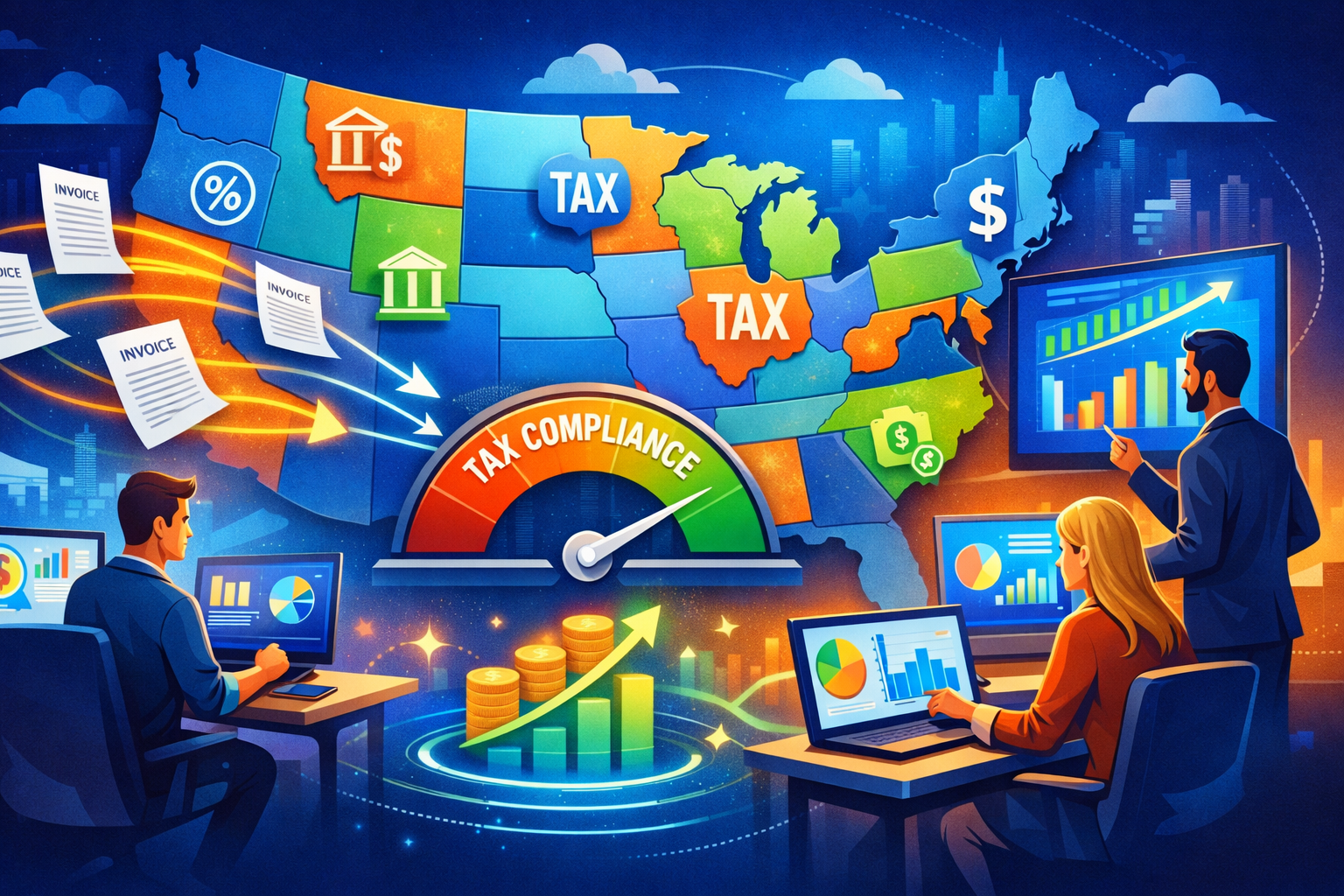

Running a business in today’s fast-paced world isn’t just about generating revenue — it’s also about ensuring compliance. For companies operating in the U.S., understanding B2B taxes in the United States is essential for maintaining smooth operations, avoiding penalties, and optimizing cash flow.
Tax laws across federal, state, and local jurisdictions can be complex. But with the right understanding and smart automation, your business can turn compliance from a challenge into a strategic advantage.
Table of Contents
Understanding the Landscape of B2B Taxation in the U.S.
Federal, State, and Local Taxes — A Multi-Layered System
The U.S. operates on multiple tax levels, each with distinct requirements:
- Federal Taxes: Apply nationwide and include corporate income and payroll taxes.
- State Taxes: Vary by state — some impose corporate income or franchise taxes, while others focus on sales tax.
- Local Taxes: Certain cities and counties add their own layers, such as local sales or business taxes.
This complexity means businesses must maintain strong oversight and accurate reporting systems.
Sales Tax vs. Use Tax — A Common Source of Confusion
Sales tax typically applies to the sale of tangible goods or taxable services. However, B2B transactions often qualify for resale exemptions if the items are purchased for resale to another business.
On the other hand, use tax applies when goods are purchased for internal use from out-of-state sellers who did not collect sales tax. Businesses must self-report and remit these taxes to stay compliant.
Economic Nexus — Why Remote Sellers Need to Pay Attention
Since the 2018 South Dakota v. Wayfair ruling, states can enforce tax collection obligations on businesses even without physical presence, based solely on sales volume or transaction count.
For B2B businesses selling across multiple states, tracking where nexus is established and ensuring accurate tax collection can be extremely challenging without automation.
Common B2B Tax Challenges Businesses Face
1. Managing Multi-State Tax Compliance
Every state has unique deadlines, rates, and filing formats. Manually tracking all of this is prone to human error and time delays.
2. Maintaining Exemption Certificates
Resale or manufacturing certificates must be accurate and up to date. Losing or mismanaging them can result in audit penalties or back taxes owed.
3. Disconnected Financial Systems
When invoices, payments, and tax data are spread across multiple platforms, reconciliation becomes a nightmare. Without centralized visibility, it’s easy to miss reporting discrepancies.
4. Manual Reconciliation and Reporting
Manual entry is not only time-consuming but risky. Automating tax and receivables management ensures greater accuracy and faster reporting.
How Automation Transforms B2B Tax Management
Modern finance teams no longer rely on spreadsheets or manual uploads. Automation simplifies compliance by offering real-time visibility and accuracy.
1. Automated Invoice-Tax Matching
With financial automation tools, invoices are automatically matched with corresponding tax records, instantly identifying errors or missing data points.
2. Centralized View of Accounts and Tax Obligations
FinFloh provides a unified dashboard where finance teams can monitor receivables, tax liabilities, and customer balances — all in one place.
3. Streamlined Reporting and Audit Readiness
Automated reconciliation and real-time data ensure that when auditors knock, your reports are accurate and complete — without last-minute scrambles.
Best Practices for Handling B2B Taxes
- Stay Current with Tax Law Updates: U.S. tax laws are dynamic. Regularly review changes across states.
- Digitize All Documentation: Keep exemption certificates, invoices, and filings in a centralized digital format.
- Automate Wherever Possible: Automation saves time and eliminates human errors.
- Integrate AR and Tax Systems: Seamless integration ensures accurate, real-time reporting.
- Conduct Regular Internal Reviews: Catch compliance gaps early before they escalate.
FAQs on B2B Taxes in the United States
1. What taxes apply to B2B companies in the U.S.?
B2B businesses are subject to federal, state, and local taxes — including income, payroll, and sales/use taxes, depending on location and operations.
2. Are B2B transactions exempt from sales tax?
Some are. If you’re selling to another business for resale, the transaction may be exempt — but proper exemption documentation is critical.
3. What is an economic nexus, and why does it matter?
An economic nexus occurs when your company meets sales or transaction thresholds in a state, even without a physical presence, triggering tax collection responsibilities.
4. How does automation help with B2B tax management?
Automation tools like FinFloh streamline tax data collection, automate reconciliations, and reduce errors, saving hours of manual work.
5. What happens if I fail to collect or remit sales tax?
You could face fines, penalties, or even personal liability depending on the state. Staying proactive with compliance is key.
6. How often should businesses review their tax compliance setup?
Twice a year is ideal, or immediately after major changes in operations, revenue thresholds, or state tax laws.
Conclusion: Why FinFloh Is Your Perfect Partner in Tax and Receivables Automation
In the complex world of B2B taxes in the United States, accuracy, visibility, and control are everything. That’s exactly where FinFloh helps.
FinFloh empowers finance teams with automation that goes beyond simple reminders — it brings intelligence to receivables, reconciliation, and compliance. From matching invoices and tax data to monitoring customer balances and streamlining audits, FinFloh gives your team the clarity and confidence they need to focus on growth instead of paperwork.
In short, FinFloh helps you stay compliant, reduce manual workload, and speed up collections — all while keeping your tax data clean, connected, and audit-ready.
Book a personalized demo with FinFloh and discover how automation can transform your finance operations.
