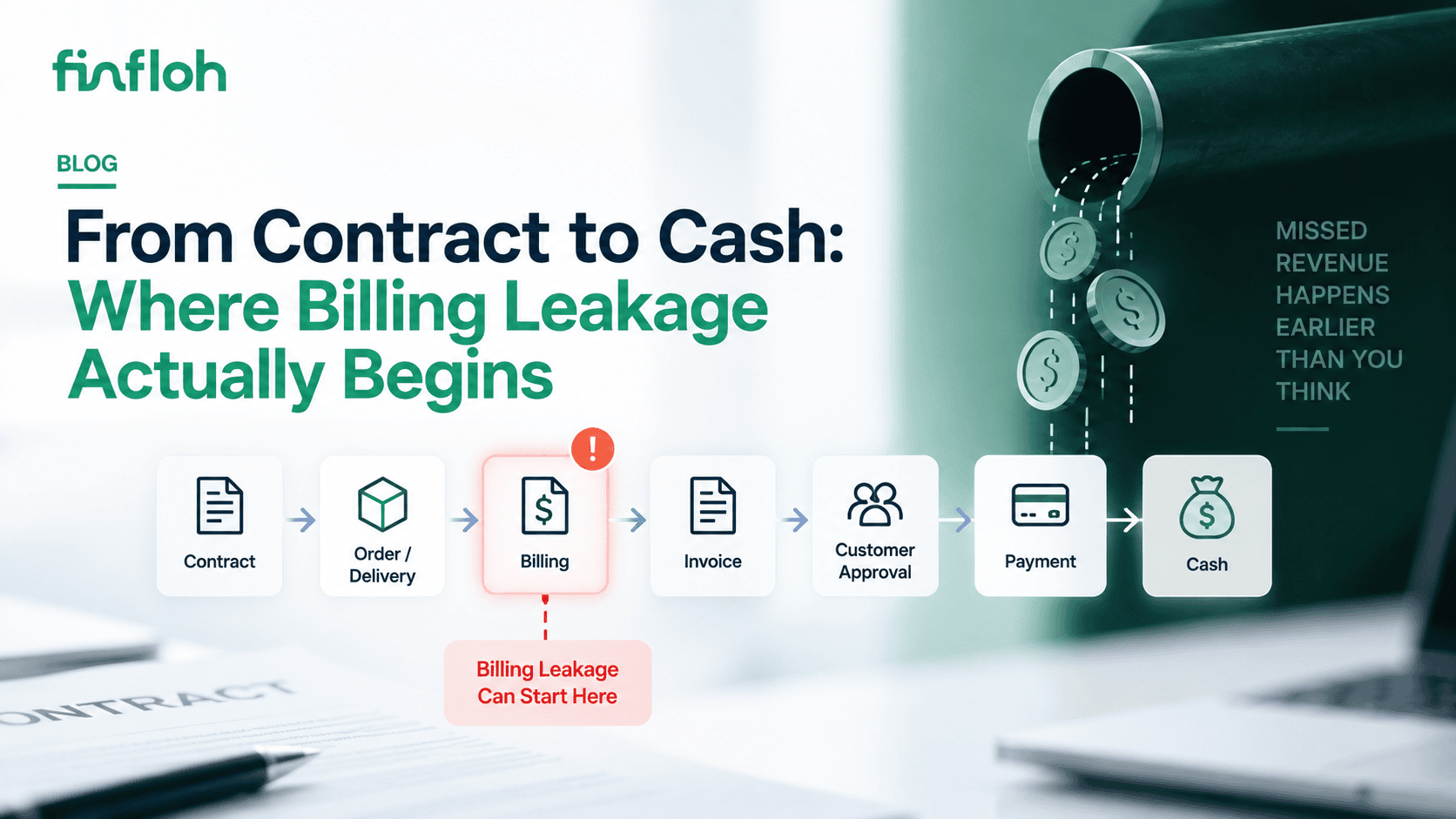

Billing leakage rarely starts when an invoice is sent. It often begins much earlier in the contract-to-cash process.
A pricing change that never reaches the billing system, an unbilled service, an incorrect discount, or a missed contract renewal can all result in revenue that a business has earned but never fully billed.
For CFOs focused on revenue realization and working capital, understanding where billing leakage begins is critical.
Table of Contents
What Is Billing Leakage?
Billing leakage occurs when a business fails to bill or collect the full amount it is entitled to under its commercial agreements.
It can result from:
- Incorrect pricing
- Missed billable items
- Unbilled services or usage
- Incorrect discounts
- Contract changes not reflected in billing
- Incorrect credit notes
- Invoice errors
The individual amounts may appear small, but across thousands of transactions, the impact can be significant.
Where Billing Leakage Begins
1. Contract Terms
Contracts can contain complex pricing, volume commitments, discounts, renewals, and other commercial terms.
Firms must ensure terms are accurately reflected in downstream billing processes to ensure revenue isn’t missed.
2. Contract Changes
Customer relationships evolve. Firms may need to change prices, quantities, services, and payment terms.
If these amendments are not properly communicated to billing teams, invoices may continue to reflect outdated terms.
3. Delivery and Usage
Products or services may be delivered beyond what was originally captured in an order.
If the additional products, services, or usage are not captured for billing, the business may leave revenue unbilled.
4. Billing
Billing rules and configurations can introduce errors.
Incorrect pricing, discounts, billing frequency, or customer-specific terms can result in invoices that don’t accurately reflect the commercial agreement.
5. Invoicing
Firms can have errors in the final invoice leading to disputes and payment delays inspite of correct billing information.
A valid invoice would stay unpaid with a missing purchase order number, incorrect amount or incomplete supporting information.
Why Billing Leakage Matters to CFOs
Billing leakage directly impacts:
- Revenue realization
- Cash flow
- Working capital
- Gross margins
- Financial forecasting
More importantly, leakage can remain hidden. Though finance teams typically have strong visibility into what was invoiced, they don’t have visibility into what should have been invoiced.
Common Signs of Billing Leakage
CFOs and finance teams should watch for:
Unbilled Revenue
Firms have delivered products or services and have not generated invoices.
Pricing Differences
The price billed differs from the price agreed with the customer.
Unexpected Credit Notes
Frequent or unusual credit notes may indicate billing errors or weaknesses in the underlying process.
Increasing Invoice Disputes
A rise in disputes can indicate recurring problems with pricing, quantities, documentation, or contract terms.
Missed Recurring Charges
Firms can miss subscription, maintenance, or recurring service charges during contract renewals and modifications.
Why Billing Leakage Is Difficult to Detect
Billing information is often spread across multiple systems. Contract information sits with sales or legal teams, while orders, delivery data, billing. Teams manage receivables elsewhere.
This creates a gap between:
What was agreed → What was delivered → What was billed → What was collected
The larger the gap between these systems, the harder it becomes to identify revenue leakage.
How Technology Can Help
Modern finance technology can help businesses compare information across the contract-to-cash lifecycle and identify inconsistencies.
This can include:
- Comparing contracted and billed values
- Identifying missing billing information
- Monitoring invoice exceptions
- Tracking credit notes and adjustments
- Identifying recurring dispute patterns
- Connecting billing information with receivables data
The objective is to identify potential leakage before it becomes a collection problem.
How Can FinFloh Help?
FinFloh helps finance teams improve visibility across the invoice-to-cash lifecycle.
By bringing together invoice, customer, payment, dispute, and receivables information, FinFloh helps teams identify exceptions and understand what is happening across their receivables.
This gives finance teams better visibility into:
- Invoices and outstanding receivables
- Customer payment activity
- Disputes and deductions
- Billing-related exceptions
- Revenue that may require attention
Finance teams can use FinFloh to look beyond invoice payments and to understand whether the underlying billing and receivables process is working correctly.
To know more about how FinFloh can help, you can visit this contract intelligence and invoicing page.
Best Practices to Reduce Billing Leakage
Maintain Accurate Contract and Customer Data
Firms can ensure consistent updation of commercial terms and customer information across systems.
Monitor Unbilled Revenue
Firms can regularly identify products, services, or usage not invoiced.
Track Billing Exceptions
Review pricing differences, adjustments, credit notes, and recurring invoice issues.
Analyze Dispute Patterns
Recurring disputes can point to underlying billing problems.
Connect Billing and AR Data
A connected view of billing and receivables makes it easier to identify gaps between invoicing and cash realization.
Conclusion
Billing leakage rarely begins with a late payment.
It often starts with a disconnect between what was agreed, what was delivered, and what was ultimately billed.
CFOs need to address billing leakage by looking beyond the invoice itself and understanding the entire contract-to-cash process.
Busineses can identify gaps by improving visibility across billing and receivables. This aids in protecting revenue and ensuring that the value they deliver is the value they ultimately realize.
