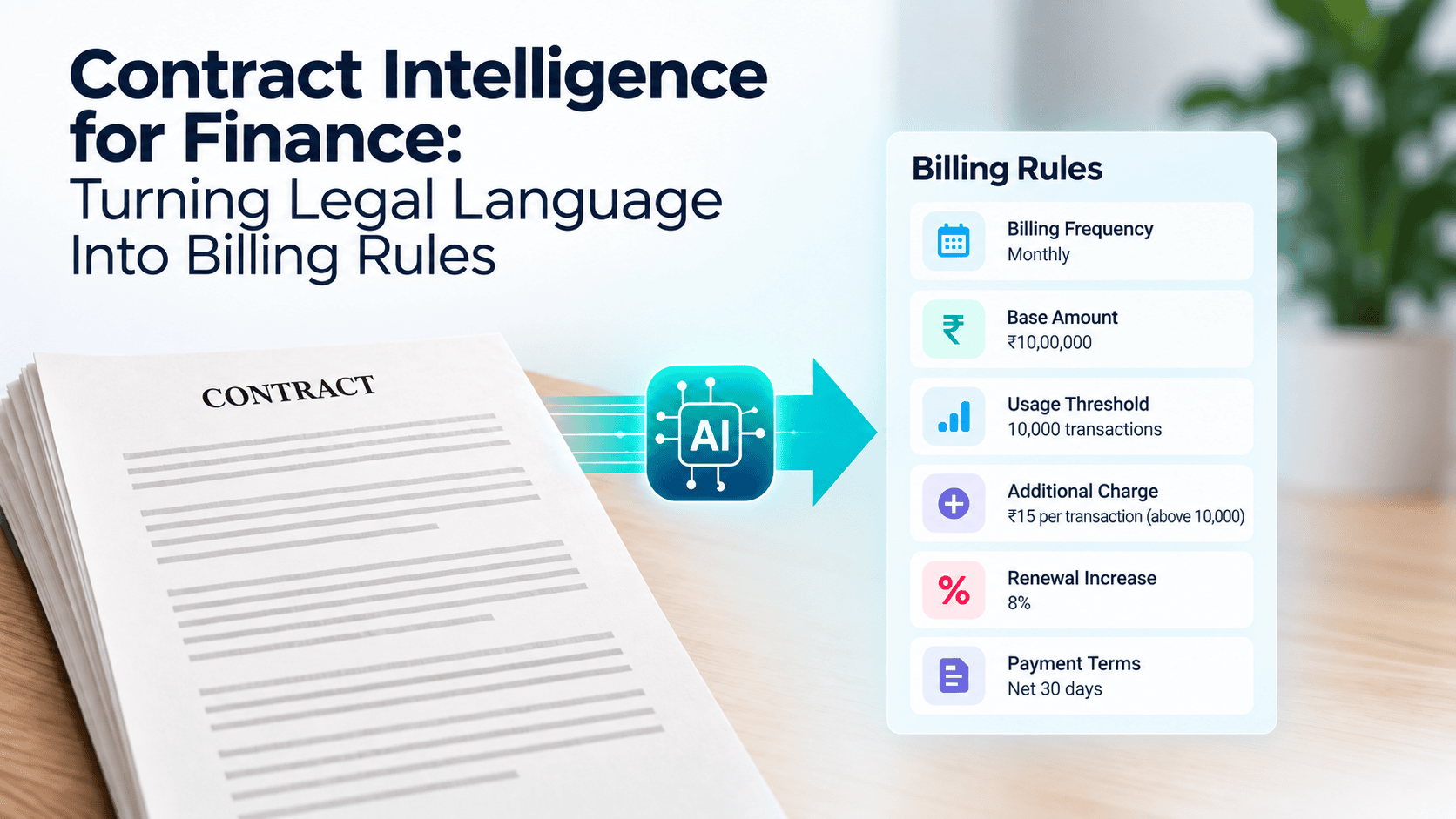

Contracts are written to define commercial relationships. Billing systems, however, need something much more structured: rules.
A contract may say that a customer will be billed monthly, receive a volume-based discount, pay an additional fee after crossing a usage threshold, or receive a price increase at renewal. These terms make sense to a legal or commercial team, but they cannot always be directly translated into a billing system.
This gap between what the contract says and what the billing system does is where revenue leakage, billing errors, disputes, and delayed collections can begin.
For finance teams, contract intelligence is therefore not simply about extracting information from contracts. It is about turning contractual language into financially actionable billing rules.
Table of Contents
What Is Contract Intelligence for Finance?
Contract intelligence uses AI and structured data extraction to understand the commercial and financial meaning of contracts.
Traditional contract extraction may identify:
- Contract start and end dates
- Customer name
- Contract value
- Payment terms
- Renewal date
- Currency
- Products or services
For finance, that is only the starting point.
Finance needs to understand questions such as:
- When should the customer be billed?
- What exactly should be billed?
- What pricing applies?
- When does a discount apply?
- Are there minimum commitments?
- What triggers an additional charge?
- When does pricing change?
- What conditions must be met before an invoice can be issued?
The objective is to move from:
Contract language → Extracted information
to:
Contract language → Financial rules → Billing action
Why Finance Needs More Than Contract Data
A contract can contain dozens of commercially important conditions that do not appear as simple fields.
Consider a clause such as:
The customer will be charged ₹10 lakh per month for up to 10,000 transactions. Transactions above this threshold will be charged at ₹15 per transaction.
A basic contract extraction system may identify:
- Contract value: ₹10 lakh
- Billing frequency: Monthly
- Usage: 10,000 transactions
- Additional charge: ₹15
But finance needs to translate this into a rule:
Monthly billing rule
- Base charge = ₹10 lakh
- Included volume = 10,000 transactions
- Additional volume = transactions above 10,000
- Additional charge = ₹15 per transaction
- Billing frequency = Monthly
Now the contract can be compared with actual usage and invoicing.
If the customer generates 12,000 transactions but the invoice contains only ₹10 lakh, there is potentially ₹30,000 of unbilled revenue.
This is the difference between extracting contract information and creating financial intelligence.
Turning Contract Language Into Billing Rules
There are several common types of contractual language that finance teams need to convert into billing logic.
1. Fixed Recurring Charges
A contract might state:
Customer will be billed ₹5 lakh per month for the services provided.
The corresponding billing rule could be:
Billing frequency: Monthly
Base amount: ₹5 lakh
Start date: Contract commencement
End date: Contract expiry
The system can then check whether the expected ₹5 lakh charge appears every month.
If an invoice is generated for ₹4 lakh, the difference can be flagged for investigation.
2. Usage-Based Charges
Contracts frequently include pricing linked to consumption.
For example:
Customer will pay ₹50 per transaction above 100,000 transactions per month.
This needs to become a rule:
Included volume: 100,000
Threshold: 100,000
Additional rate: ₹50
Measurement period: Monthly
The finance team can then compare actual usage with invoiced quantities.
This is particularly important for businesses with:
- API usage
- Cloud consumption
- Transactions
- Seats or users
- Storage
- Logistics volume
- Advertising impressions
- Communication usage
3. Volume-Based Discounts
Discounts can be particularly difficult to manage because they may depend on thresholds.
For example:
Customers processing more than 50,000 transactions per month receive a 7% discount.
The billing rule becomes:
Threshold: 50,000 transactions
Discount: 7%
Measurement: Monthly
Trigger: Actual transactions exceed threshold
The finance team can then verify whether the discount was correctly applied.
Contract intelligence can also help identify situations where a discount has been applied even though the contractual conditions were not met.
4. Minimum Commitments
Some contracts require customers to pay for a minimum level of usage regardless of actual consumption.
For example:
Customer commits to a minimum monthly spend of ₹20 lakh.
The billing rule is different from a simple recurring fee.
The system needs to understand:
Minimum commitment: ₹20 lakh/month
Actual usage: ₹16 lakh
Minimum billing requirement: ₹20 lakh
Potential billing gap: ₹4 lakh
Without understanding the contractual commitment, an AR system may simply see a ₹16 lakh invoice and consider it valid.
Contract Amendments
Contracts rarely remain unchanged throughout their lifecycle.
Pricing, scope, quantities, payment terms, and service requirements can change through amendments.
For example:
Original contract: ₹10 lakh/month
Amendment: ₹12 lakh/month effective July 1
The billing system needs to apply ₹10 lakh through June and ₹12 lakh from July.
If the amendment remains in a contract repository but never reaches the billing process, invoices may continue to be generated using the old amount.
This creates a direct connection between contract change management and revenue leakage.
Renewal-Based Price Changes
Renewal clauses can contain another important billing rule.
For example:
Fees will increase by 8% upon annual renewal.
The financial rule becomes:
Current price: ₹10 lakh/month
Renewal date: January 1
Increase: 8%
New price: ₹10.8 lakh/month
The key question for finance is not simply whether the renewal date exists.
It is:
Did the billing amount actually change when the renewal became effective?
Conditional Billing
Some contracts allow billing only when specific conditions are satisfied.
For example:
50% of the project fee will be invoiced upon completion and acceptance of the implementation milestone.
This creates a billing dependency:
Milestone completed → Customer acceptance → Invoice eligible
A contract intelligence system can identify the dependency and make it visible to finance.
This can help distinguish between:
- Revenue that is not yet billable
- Revenue that is billable but has not been invoiced
- Revenue that has been invoiced but remains unpaid
That distinction is important for both billing and AR management.
From Legal Language to Structured Rules
The transformation can be thought of as four stages:
Contract
↓
Identify Commercial Terms
↓
Convert Terms Into Financial Rules
↓
Compare Rules With Actual Billing
For example:
| Contract language | Financial rule |
|---|---|
| ₹5 lakh per month | Monthly charge = ₹5 lakh |
| 10,000 units included | Included quantity = 10,000 |
| ₹20 per additional unit | Excess usage rate = ₹20 |
| 5% increase on renewal | New price = previous price × 1.05 |
| Minimum commitment of ₹15 lakh | Minimum monthly billing = ₹15 lakh |
| 30-day payment term | Due date = invoice date + 30 days |
This structured representation makes contractual information usable by finance systems.
Why Traditional Processes Struggle
The problem is not necessarily a lack of contract information.
The problem is that the information is distributed across different systems and teams.
A typical process may look like:
Sales / Legal → Contract
Operations → Delivery / Usage
Billing → Invoice
AR → Receivables / Collections
Each function may have visibility into its own part of the process.
Finance, however, needs to answer a broader question:
Was the customer billed according to the commercial agreement?
That requires connecting the contract with actual billing and financial activity.
The Role of AI in Contract Intelligence
AI can help interpret contractual language that is difficult to represent through simple fields.
Instead of asking only:
What is the contract value?
AI can identify:
What conditions determine how this customer should be billed?
It can identify concepts such as:
- Billing triggers
- Pricing formulas
- Volume thresholds
- Minimum commitments
- Discounts
- Rebates
- Renewal increases
- Usage-based charges
- Milestone-based billing
- Payment dependencies
- Customer-specific exceptions
The next step is to convert those observations into structured rules that finance systems can use.
Contract Intelligence and Revenue Leakage
The real value appears when contractual rules are compared against actual financial activity.
For example:
Contract
₹10 lakh monthly fee
8% renewal increase
₹20 per excess transaction
Actual activity
Renewal completed
Monthly invoice remains ₹10 lakh
Usage exceeds contractual threshold
Finance insight
The contract indicates that the expected billing amount should have changed and additional usage may be billable.
This moves contract intelligence from a document-management exercise to a revenue assurance process.
Contract → Billing → AR → Cash
Contract intelligence becomes even more useful when connected to the broader invoice-to-cash process.
The relationship can be viewed as:
Contract
→ What was agreed?
Delivery / Usage
→ What was actually delivered?
Billing
→ What should have been billed?
Invoice
→ What was actually invoiced?
Receivables
→ What remains outstanding?
Payment
→ What was actually collected?
This creates a continuous financial view of the customer relationship.
The important gap is:
What should have been billed vs. what was actually billed.
How FinFloh Helps
FinFloh brings together financial information across the invoice-to-cash process, including customer, invoice, payment, receivables, disputes, and collections data.
Contract intelligence can add the commercial context behind that financial data.
This can help finance teams:
- Understand customer-specific billing requirements
- Identify pricing and billing exceptions
- Detect missed recurring charges
- Monitor contract amendments
- Identify renewal-related billing changes
- Compare contractual expectations with actual invoices
- Investigate potential billing gaps
- Understand how contractual conditions contribute to disputes
The objective is not simply to store contracts or extract fields from them.
It is to make the financial meaning of the contract usable by finance.
To know more about how FinFloh helps, you can check out FinFloh Contract Intelligence product page.
Best Practices for Finance Teams
1. Start With Billing-Relevant Terms
Focus first on terms that directly affect revenue and cash:
- Pricing
- Billing frequency
- Discounts
- Minimum commitments
- Usage thresholds
- Renewals
- Payment conditions
- Billing triggers
2. Connect Contracts With Actual Billing
Contract information becomes significantly more useful when it can be compared with invoices and receivables.
3. Track Amendments
An amendment that is not reflected in downstream systems can create a billing discrepancy.
4. Monitor Exceptions
Not every contract needs constant manual review. Focus attention on situations where contractual expectations and actual billing differ.
5. Treat Contract Intelligence as a Continuous Process
Contracts change. Customers expand. Pricing changes. Renewals occur.
Contract intelligence should therefore extend beyond the initial contract review.
Conclusion
For finance teams, the value of contract intelligence is not simply knowing what a contract says.
It is understanding what the contract requires the business to bill.
A clause about pricing becomes a billing rule.
A volume commitment becomes a threshold.
A renewal clause becomes a price-change rule.
A milestone becomes a billing trigger.
A discount clause becomes a calculation.
Once legal language can be translated into structured financial rules, finance teams can compare what was agreed with what was actually billed.
That creates a stronger connection between contracts, billing, receivables, and cash — and gives finance greater visibility into revenue that might otherwise remain hidden.
