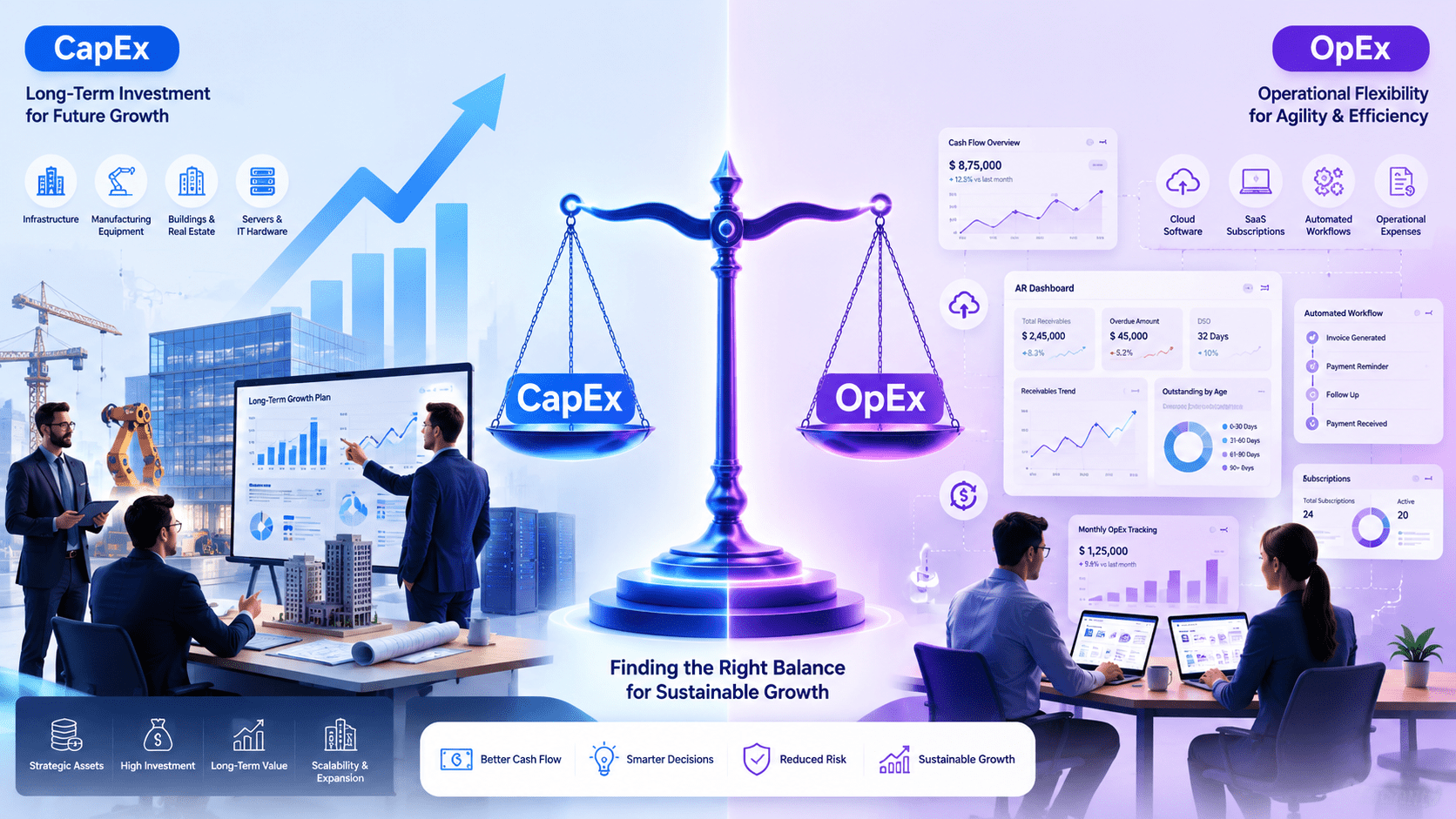

Every growing business eventually faces the same financial question:
Should we invest heavily in long-term assets or keep operations flexible with ongoing expenses?
Finding the right balance between CapEx and OpEx is critical for maintaining healthy cash flow, improving operational efficiency, and scaling sustainably. While both play an important role in business growth, leaning too far in one direction can create financial strain, reduced agility, or missed opportunities.
Businesses today need a smarter financial strategy — one that balances long-term investments with operational flexibility while keeping working capital optimized.
Table of Contents
What Is CapEx?
Capital Expenditure (CapEx) refers to the money businesses spend on acquiring, upgrading, or maintaining long-term assets.
Common Examples of CapEx
- Purchasing machinery or equipment
- Buying office buildings or warehouses
- Investing in enterprise software infrastructure
- Upgrading IT systems
- Manufacturing plant expansion
CapEx investments are usually large upfront expenses designed to generate value over several years.
Benefits of CapEx
- Supports long-term business growth
- Improves productivity and operational capacity
- Creates asset ownership
- Can offer tax depreciation benefits
Challenges of CapEx
- Requires significant upfront capital
- Impacts short-term cash flow
- Slower return on investment
- Less financial flexibility during uncertain markets
What Is OpEx?
Operational Expenditure (OpEx) includes the day-to-day costs required to run a business.
Common Examples of OpEx
- Employee salaries
- Cloud software subscriptions
- Rent and utilities
- Marketing expenses
- Maintenance and support services
- Outsourced operations
Unlike CapEx, OpEx is recorded as an ongoing operating expense during the accounting period.
Benefits of OpEx
- Lower upfront costs
- Greater financial flexibility
- Easier budgeting and forecasting
- Faster scalability
- Better adaptability during market changes
Challenges of OpEx
- Continuous recurring costs
- Can become expensive over time
- Limited ownership of assets
- Dependency on third-party providers
Why Finding the Right Balance Between CapEx and OpEx Matters?
Businesses that focus only on CapEx may face liquidity pressure, while companies relying entirely on OpEx could struggle with rising long-term operational costs.
The ideal strategy depends on:
- Business size
- Growth stage
- Industry
- Cash flow stability
- Risk appetite
- Technology requirements
A balanced financial model allows organizations to:
- Preserve working capital
- Maintain operational agility
- Reduce financial risk
- Scale efficiently
- Improve forecasting accuracy
How Modern Businesses Are Shifting Their Strategy?
Over the last few years, many companies have started shifting from heavy CapEx investments toward more flexible OpEx models.
Why the Shift Is Happening?
- Cloud-based technologies reduce infrastructure costs
- Subscription software lowers upfront investments
- Economic uncertainty increases demand for flexibility
- Faster digital transformation cycles require agility
For example, businesses that once invested heavily in on-premise financial systems now prefer SaaS platforms that operate on a subscription basis.
This approach helps companies conserve cash while still accessing advanced technology.

Balancing CapEx and OpEx During Economic Uncertainty
Economic volatility makes financial planning even more important.
Businesses Should Focus On:
1. Preserving Cash Flow
Maintaining liquidity helps businesses navigate market disruptions without operational stress.
2. Prioritizing High-ROI Investments
CapEx spending should focus on assets that directly improve revenue generation or operational efficiency.
3. Leveraging Flexible Technology
Using scalable subscription-based platforms reduces long-term financial commitments.
4. Improving Financial Visibility
Real-time insights into receivables, collections, and cash flow help finance teams make smarter spending decisions.
The Role of Accounts Receivable in Managing CapEx and OpEx
One overlooked factor in balancing CapEx and OpEx is accounts receivable efficiency.
Delayed payments and poor collections directly impact:
- Available working capital
- Liquidity
- Investment decisions
- Operational spending flexibility
Businesses with slow receivables often struggle to:
- Fund strategic CapEx projects
- Manage operational costs effectively
- Maintain stable cash flow
This is why modern finance teams are investing in AR automation and cash flow optimization tools.
How Automation Helps Businesses Maintain Financial Balance?
Automation helps organizations reduce unnecessary operational costs while improving cash flow visibility.
Key Benefits of Financial Automation
1. Faster Collections
Automated reminders and workflows reduce payment delays.
2. Better Cash Flow Forecasting
Real-time analytics improve financial planning accuracy.
3. Reduced Manual Work
Finance teams spend less time on repetitive tasks.
4. Improved Decision-Making
Centralized dashboards provide better visibility into financial performance.
By automating receivables and financial workflows, businesses can better allocate resources between CapEx investments and operational spending.
Conclusion : Build a Smarter Financial Strategy
There is no universal formula for the perfect CapEx and OpEx mix. The right approach depends on your company’s goals, industry, and financial position.
However, businesses that succeed long-term usually focus on:
- Maintaining healthy cash reserves
- Investing strategically
- Staying operationally flexible
- Leveraging automation
- Improving working capital management
A balanced approach allows businesses to grow confidently while remaining resilient during market changes.
Talk to Our Experts or book a demo to improve cash flow visibility and optimize your financial operations.
