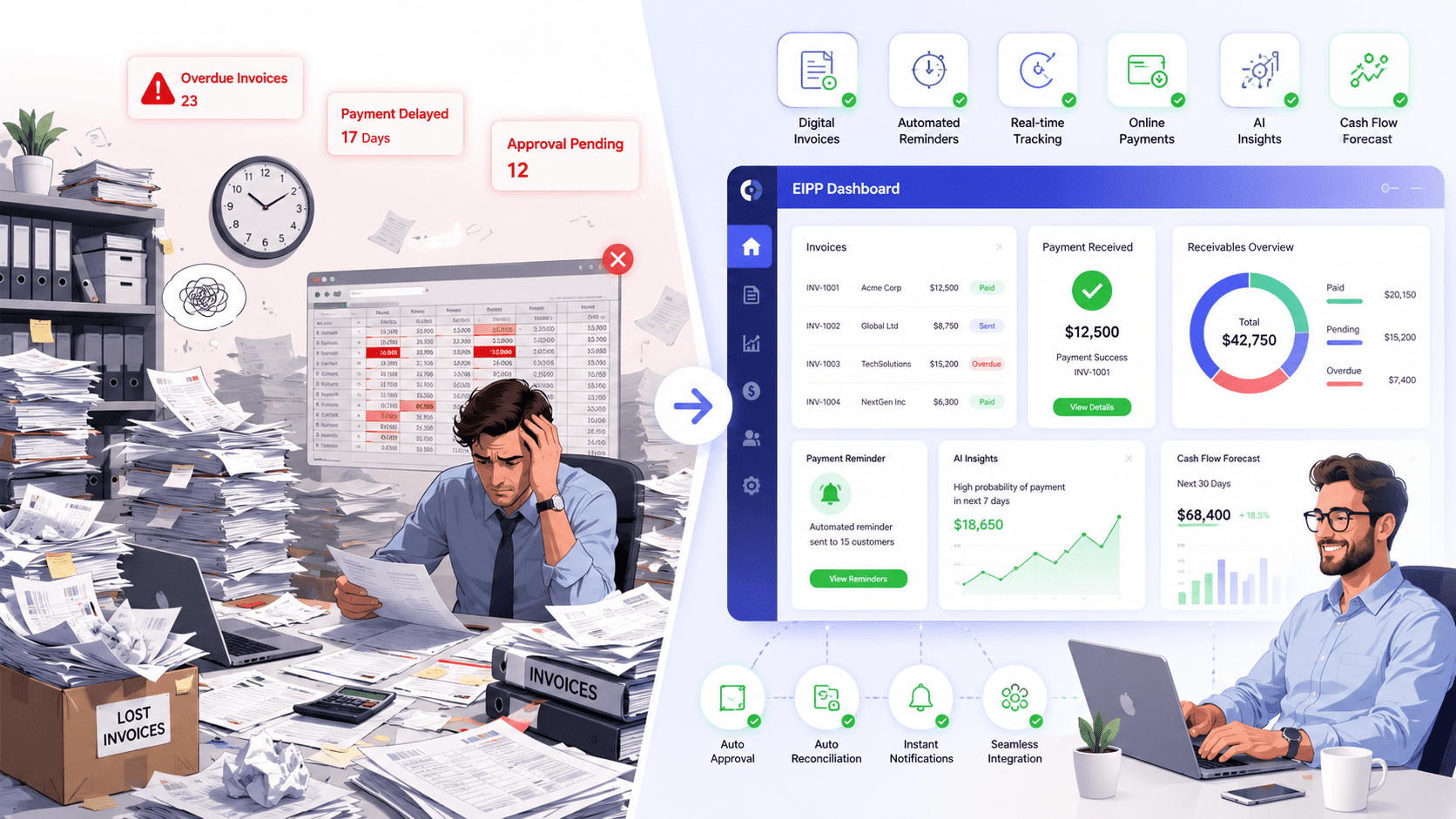

Managing invoices manually can slow down payments, increase errors, and create unnecessary pressure on finance teams. That’s why many businesses are now shifting toward EIPP invoices to simplify billing and improve accounts receivable efficiency.
Electronic Invoice Presentment and Payment (EIPP) helps businesses digitally send invoices, track payments in real time, automate reminders, and offer customers faster payment options — all from a single platform. Instead of relying on paper invoices, spreadsheets, or scattered email chains, EIPP creates a streamlined invoicing experience for both finance teams and customers.
In this blog, we’ll break down how EIPP invoices work, why businesses are adopting them, and how automation platforms like FinFloh help companies modernize their receivables process.
Table of Contents
What Are EIPP Invoices?
EIPP invoices are electronic invoices delivered and managed through an Electronic Invoice Presentment and Payment system. These platforms allow businesses to:
- Generate digital invoices
- Deliver invoices instantly
- Enable online payment options
- Automate payment reminders
- Track invoice status in real time
- Improve payment collection efficiency
Unlike traditional invoicing methods, EIPP removes manual dependencies and creates a centralized workflow for invoice management and payment processing.
Why Businesses Are Moving to EIPP Invoicing?
Traditional invoicing processes often create delays because they rely heavily on manual work. Finance teams spend hours generating invoices, following up on payments, reconciling transactions, and resolving disputes.
EIPP invoicing solves these problems by introducing automation and real-time visibility.
Key Benefits of EIPP Invoices
1. Faster Payment Cycles
Digital invoices reach customers instantly, reducing delays caused by physical paperwork or email backlogs.
2. Improved Cash Flow Visibility
Finance teams can track invoice statuses, payment timelines, and outstanding receivables in real time.
3. Reduced Manual Errors
Automation minimizes duplicate entries, invoice mismatches, and reconciliation issues.
4. Better Customer Experience
Customers can view invoices online, access payment portals, and pay using multiple digital payment methods.
5. Automated Collections
EIPP systems automatically send reminders and follow-ups for overdue invoices, reducing manual collection efforts.

How EIPP Invoices Work?
Understanding how EIPP invoices work becomes easier when you break the process into stages.
1. Invoice Creation
The finance team generates an invoice using ERP software or an AR automation platform.
The invoice includes:
- Customer details
- Payment terms
- Due dates
- Tax information
- Itemized billing data
Modern EIPP systems automatically pull this information from connected accounting or ERP systems.
2. Electronic Invoice Delivery
Once generated, the invoice is delivered digitally through:
- Customer portals
- Supplier networks
- Integrated payment platforms
This removes printing, courier, and mailing delays.
3. Invoice Presentment
Customers receive the invoice through a secure online portal where they can:
- Review invoice details
- Download invoices
- Raise disputes
- Access payment history
- Track due dates
This centralized visibility improves communication between businesses and customers.
4. Online Payment Processing
EIPP platforms allow customers to pay invoices digitally using:
- Bank transfers
- Credit cards
- ACH payments
- UPI or digital wallets
- Automated recurring payments
Integrated payment gateways speed up collections and reduce payment friction.
5. Automated Payment Reminders
If payments become overdue, the EIPP platform automatically triggers:
- Payment reminders
- Escalation workflows
- Collection emails
- Follow-up notifications
Automation helps finance teams maintain consistent collections without manual chasing.
6. Reconciliation and Reporting
Once payment is received, the system automatically reconciles invoices with payment records and updates the accounting system.
Finance teams gain access to:
- Real-time AR dashboards
- Aging reports
- Cash flow forecasts
- Collection performance analytics
Key Features Businesses Should Look for in an EIPP Platform
Choosing the right EIPP solution can significantly improve invoicing and collections efficiency.
1. Automated Invoice Workflows
The platform should automate invoice generation, approvals, delivery, and reminders.
2. Real-Time Tracking
Businesses need complete visibility into invoice status and payment progress.
3. ERP Integrations
The EIPP solution should integrate seamlessly with ERP and accounting systems.
4. Secure Payment Options
Built-in payment gateways and secure digital payment methods improve customer convenience.
5. Dispute Management
Customers should be able to raise invoice disputes directly through the platform for faster resolution.
6. Analytics and Reporting
Advanced dashboards help finance teams monitor DSO, collections efficiency, and receivables performance.
Common Challenges Without EIPP Invoices
Businesses still relying on manual invoicing often struggle with:
- Delayed payments
- High DSO
- Lost invoices
- Poor customer communication
- Manual reconciliation work
- Limited payment visibility
- Inefficient collections processes
As invoice volumes increase, these inefficiencies become harder to manage manually.
How EIPP Invoices Improve Accounts Receivable Efficiency?
EIPP invoicing directly impacts AR performance by improving the speed and accuracy of invoice processing.
1. Better Collection Rates
Automated reminders ensure customers don’t miss payment deadlines.
2. Reduced Operational Costs
Digital invoicing eliminates paper handling, printing, and manual processing expenses.
3. Faster Dispute Resolution
Centralized invoice visibility reduces confusion and accelerates issue resolution.
4. Improved Financial Forecasting
Real-time payment data helps finance teams forecast cash flow more accurately.
5. Stronger Customer Relationships
Easy invoice access and flexible payment methods improve the customer payment experience.
Why EIPP Is Becoming Essential for Modern Finance Teams?
As businesses scale, managing receivables manually becomes increasingly difficult. Modern finance teams need automation, visibility, and faster payment cycles to maintain healthy cash flow.
EIPP invoicing helps organizations:
- Reduce collection delays
- Improve operational efficiency
- Increase payment visibility
- Accelerate cash flow
- Minimize accounting errors
- Strengthen AR processes
For businesses focused on digital transformation, EIPP is no longer optional — it’s becoming a core part of modern financial operations.
How FinFloh Helps Businesses Streamline EIPP Invoicing?
FinFloh helps businesses modernize accounts receivable processes through intelligent automation and real-time collections visibility.
With FinFloh, businesses can:
- Automate invoice presentment and payment workflows
- Track receivables in real time
- Send automated collection reminders
- Improve customer payment experiences
- Reduce manual reconciliation work
- Gain AI-driven cash flow insights
- Accelerate collections and reduce DSO
FinFloh enables finance teams to move beyond spreadsheets and manual collections toward a smarter, more scalable AR process.
Talk to Our Experts if you’re looking to automate your invoicing and collections process or Book a demo to discover how FinFloh can help your business simplify EIPP invoicing, improve cash flow visibility, and accelerate payments.
