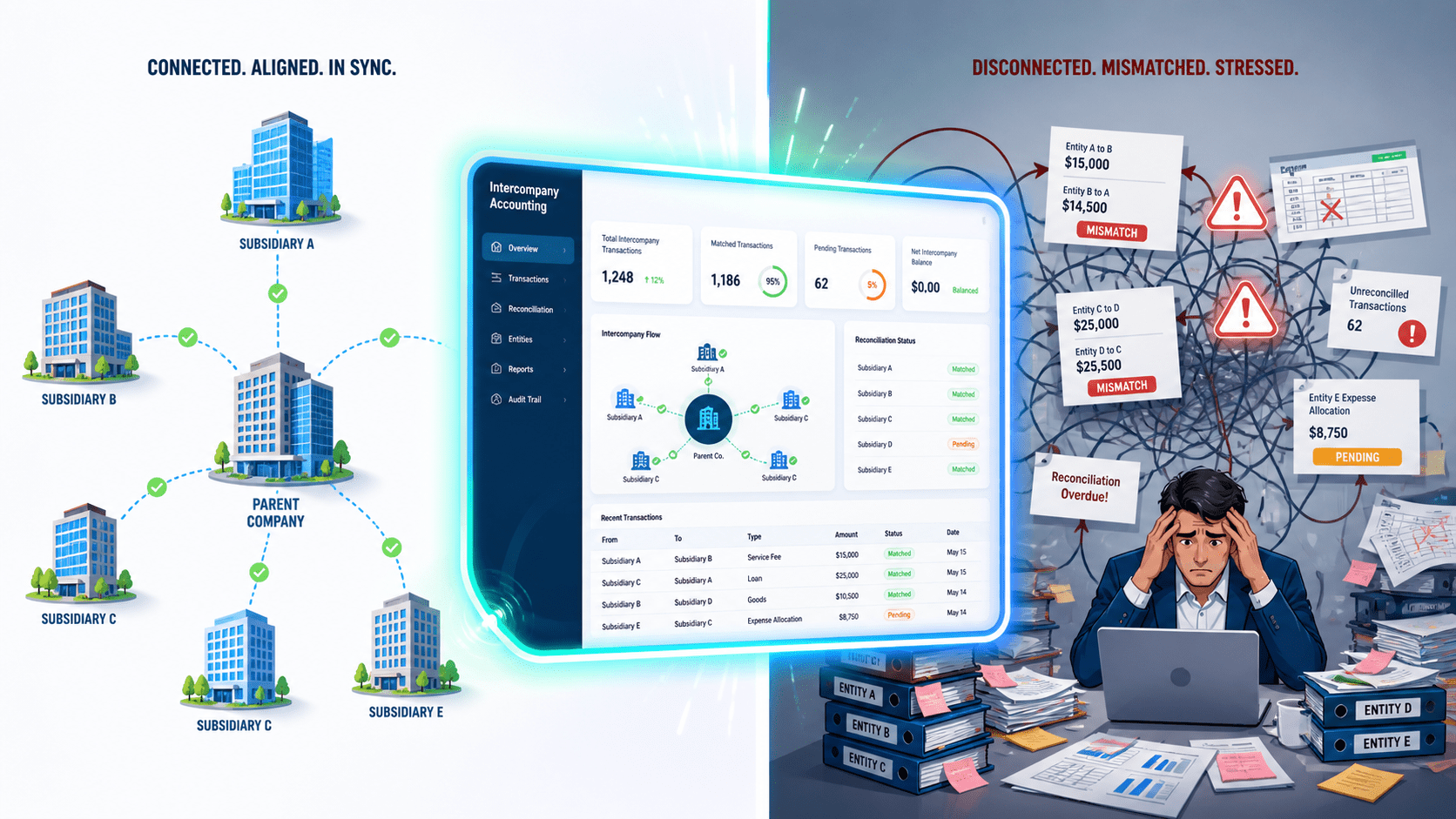

Intercompany accounting is one of those finance processes that looks simple—until you actually have to manage it across multiple entities.
One team says the payment is done.
Another says it’s still pending.
And finance is stuck reconciling numbers that don’t quite match.
If this sounds familiar, you’re already dealing with the real challenges of intercompany transactions.
Table of Contents
What Is Intercompany Accounting and Why It Matters?
At its core, intercompany accounting refers to financial transactions between entities within the same organization.
This includes:
- Sales between subsidiaries
- Shared services or cost allocations
- Loans and advances within the group
The goal is simple: ensure that both sides of every transaction match—so consolidation becomes clean and accurate.
But in reality, that’s rarely the case.
Types of Intercompany Transactions You’ll Deal With
1. Intercompany Sales and Purchases
When one entity provides goods or services to another within the group.
2. Loans and Internal Funding
Funds transferred between entities to support operations or expansion.
3. Cost Allocations
Shared expenses like HR, IT, or marketing distributed across business units.
4. Dividends and Profit Transfers
Movement of profits between subsidiaries and parent companies.
Each of these creates entries on both ends—and both sides need to align perfectly.

Why Intercompany Processes Break in Real Life?
On paper, everything looks structured. In practice, things fall apart quickly.
1. Timing Mismatches
One entity records the transaction today. Another records it next week.
2. Too Many Spreadsheets
Different formats, versions, and manual updates create confusion.
3. Currency and Compliance Complexity
Exchange rates and local regulations add layers of friction.
4. No Clear Ownership
When something doesn’t match, no one knows who should fix it.
The result?
Delays, mismatches, and long reconciliation cycles.
How Intercompany Accounting Impacts Cash Flow and Visibility?
Here’s where it gets serious.
These internal gaps don’t just affect reporting—they impact how clearly you understand your cash position.
- Payments between entities get delayed
- Balances remain unresolved for longer
- Finance teams lose real-time visibility
So while everything may look fine in reports, the underlying liquidity picture can tell a different story.
How to Fix Intercompany Accounting Without Chaos?
The best teams don’t just manage these processes—they design them to scale.
1. Standardize Workflows Across Entities
Same structure, same rules, same timelines.
2. Automate Matching and Reconciliation
Reduce manual errors and identify mismatches early.
3. Improve Cross-Team Coordination
Finance teams across entities should work in sync—not in silos.
4. Build Real-Time Visibility
Track what’s matched, pending, or disputed—without chasing emails.
Why This Matters More as You Scale?
What works for 2 entities breaks at 5.
What works in spreadsheets collapses at 10.
As complexity grows, intercompany issues multiply—and so does the time spent fixing them.
That’s why modern finance teams are moving toward:
- Centralized systems
- Automated workflows
- Better visibility across entities
Because this isn’t just accounting—it’s operational efficiency.
Conclusion: Intercompany Accounting Shouldn’t Slow You Down
Intercompany accounting is meant to keep your financials clean.
But without the right systems, it does the opposite—
creating delays, confusion, and hidden cash flow issues.
The goal isn’t just to reconcile faster.
It’s to eliminate the friction entirely.
About FinFloh: Bringing Clarity to Intercompany Accounting
At FinFloh, we work with finance teams that are tired of chasing numbers across entities.
While intercompany accounting sits at the intersection of multiple processes, the real problem often shows up in collections, reconciliation, and visibility.
FinFloh helps teams:
- Automate follow-ups and internal tracking
- Improve visibility across receivables and payables
- Reduce manual effort in reconciliation workflows
So instead of reacting to mismatches,
your team stays ahead of them—with clarity and control.
