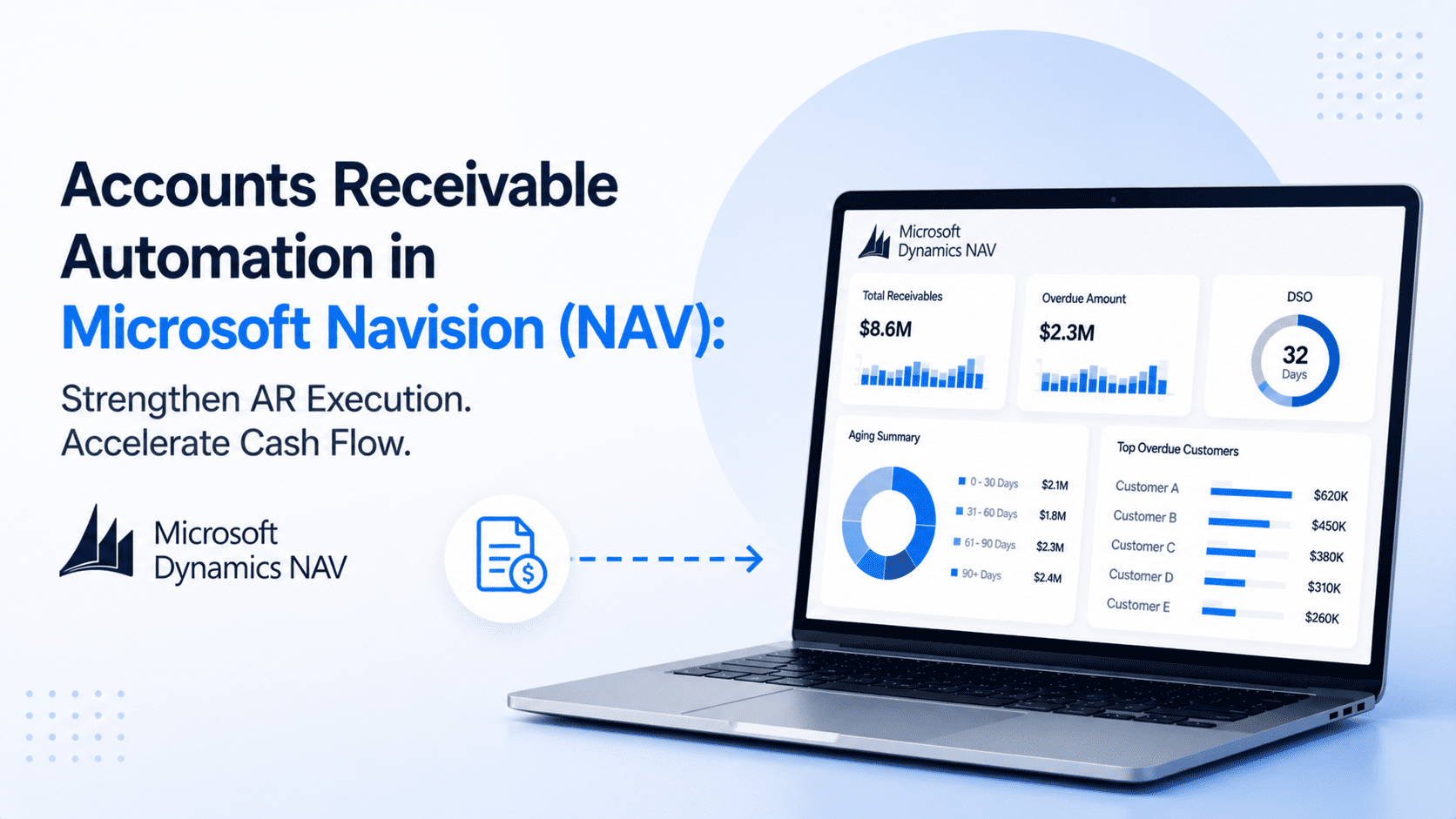

Microsoft Dynamics NAV (Navision) has long been a reliable ERP for finance teams, particularly across small and mid-sized businesses. It provides a strong foundation for managing invoices, tracking receivables, and maintaining financial records.
However, as receivables processes grow in complexity and volume, finance teams often find themselves working outside the system. While NAV performs well as a system of record, it is not designed for dynamic, real-time execution of accounts receivable workflows.
This is where modern AR automation platforms extend Microsoft Dynamics NAV to enable more proactive and scalable receivables management.
Table of Contents
Understanding Accounts Receivable in Microsoft Dynamics NAV
What Navision Does Well
NAV supports core AR processes such as invoice creation, receivables tracking, customer management, and payment posting. It provides structured financial data and ensures consistency across transactions.
For many organizations, it serves as the backbone for accounting and financial reporting.
Where Navision Has Limitations for AR Automation
NAV includes basic, rule-based capabilities such as reminders and scheduled processes. However, these are largely static and require manual oversight.
It is not designed for dynamic collections prioritization, intelligent payment matching, or end-to-end workflow orchestration. As a result, many day-to-day receivables activities are handled outside the ERP.
Why AR Processes Become Inefficient in Navision
Collections Are Largely Manual
While NAV supports basic reminders, collections typically rely on reports and manual follow-ups, making it difficult to scale and maintain consistency across customers.
Limited Real-Time Actionability
NAV provides visibility through reports, but actions are not triggered automatically. Teams need to interpret data and execute workflows manually.
Cash Application Requires Significant Effort
NAV supports payment application, but matching becomes time-consuming when remittance data is incomplete or inconsistent, often leading to unapplied cash.
Dispute Handling Is Not Workflow-Driven
Disputes can be tracked within NAV, but there is no structured, end-to-end workflow for managing resolution, which can delay closures and increase aging.

What Modern AR Automation Requires
Accounts receivable today requires continuous monitoring, intelligent prioritization, and automated execution—not just transactional tracking.
Modern AR automation platforms enable:
Proactive Collections Execution
Systems continuously monitor receivables and trigger follow-ups based on customer behavior, risk signals, and payment patterns.
Intelligent Payment Matching
Advanced matching capabilities handle fragmented and inconsistent data, reducing manual reconciliation effort.
Structured Dispute Workflows
Disputes are captured, tracked, and resolved through defined workflows with clear ownership and visibility.
Real-Time AR Insights
Finance teams gain immediate visibility into receivables, aging, and performance metrics, enabling faster decision-making.
How FinFloh Extends Navision for AR Automation
NAV provides the data foundation, while FinFloh adds the execution layer required for modern receivables management.
Seamless Integration With Navision
FinFloh integrates with NAV to leverage existing financial data without disrupting ERP workflows.
AI-Driven Collections
Collections are automated and prioritized dynamically, improving follow-up consistency and recovery rates.
Automated Cash Application
Payments are matched to invoices with higher accuracy, reducing unapplied cash and manual effort.
Dispute and Deduction Management
Structured workflows enable faster identification, tracking, and resolution of disputes.
Unified, Real-Time Visibility
Finance teams gain a complete view of receivables, collections performance, and cash flow in real time.
To implement FinFloh’s AI Engine for Collections integrated with Microsoft Dynamics NAV, you can check out FinFloh Collections product page. You can also Book a Demo to see how the product works or you can Book a Free Trial for a first-hand experience of the product.
Why Finance Teams Move Beyond Navision for AR
As businesses scale, receivables complexity increases. NAV continues to serve as a strong system of record, but manual processes become harder to manage efficiently.
Finance teams often spend more time coordinating workflows than improving outcomes. By introducing an automation layer, organizations can shift from reactive collections to proactive cash flow management.
Best Approach to Modernizing AR in Navision
Retain Navision as the System of Record
Continue using NAV for financial data management and compliance.
Add an Automation Layer for Execution
Introduce a platform like FinFloh to handle collections, cash application, and dispute workflows dynamically.
Focus on High-Impact Areas First
Start with collections and cash application, where automation delivers immediate value.
Continuously Optimize With Data
Use real-time insights to refine strategies, reduce DSO, and improve performance over time.
Conclusion
Microsoft Navision is a strong ERP for managing financial data, but it is not designed for modern accounts receivable automation.
As finance teams deal with increasing complexity, relying solely on ERP-driven processes can lead to inefficiencies and delays. By extending NAV with an automation layer like FinFloh, businesses can unlock faster collections, improved visibility, and scalable AR operations.
The future of accounts receivable is not just about recording transactions—it is about executing intelligently on top of them.

Automating Accounts Receivable in Microsoft Dynamics 365 with FinFloh