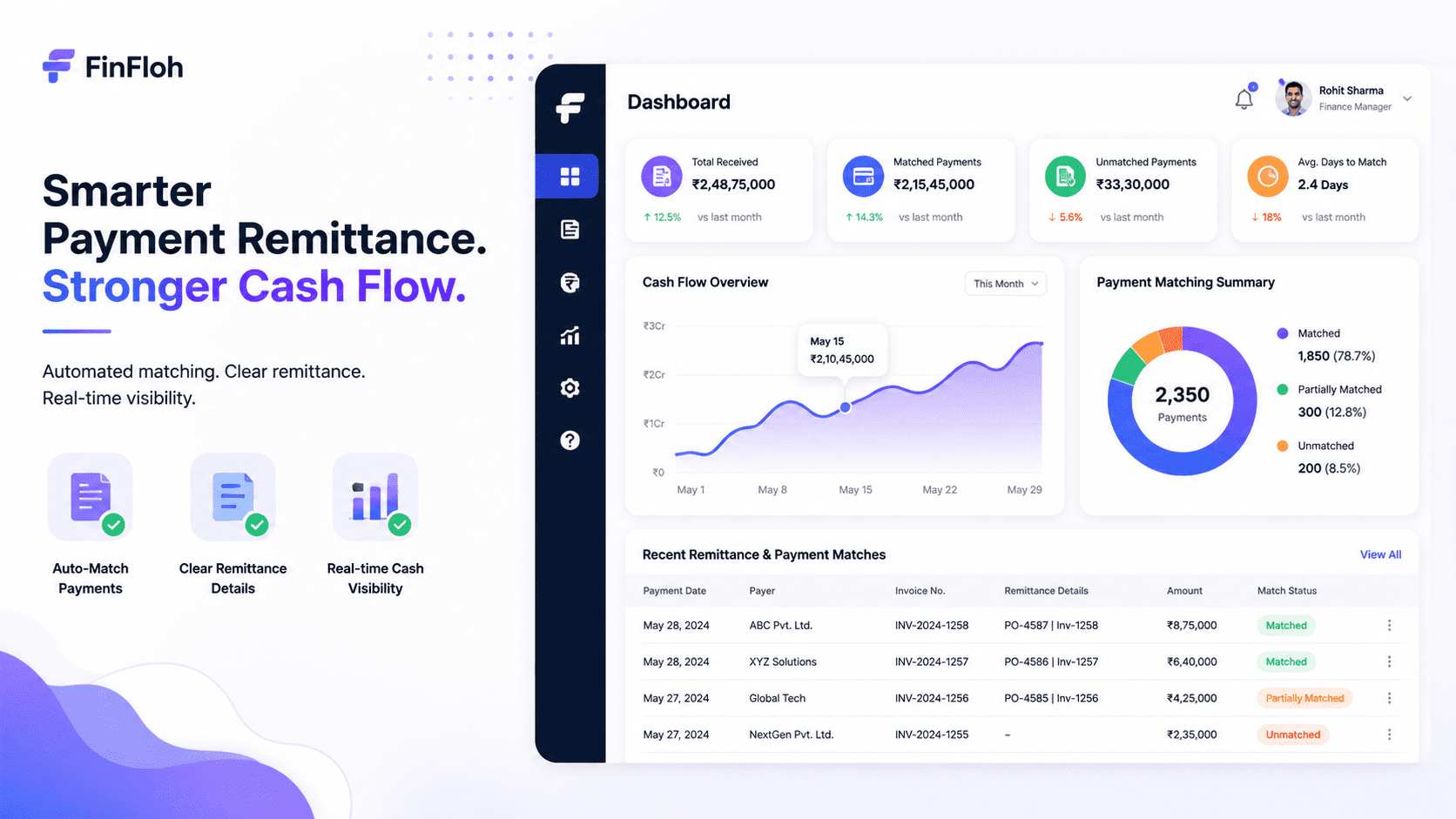

If you’ve ever received a payment but had no clue which invoice it belongs to—you’ve already felt the pain of payment remittance.
Payment remittance is more than just sending money. It’s the information that tells you what the payment is for. Without it, your finance team ends up guessing, chasing customers, or manually matching invoices.
And that’s where cash flow starts getting messy.
Table of Contents
What Is Payment Remittance?
At its core, payment remittance refers to the details a payer shares when making a payment—so the recipient knows exactly which invoice or account the payment settles.
What Does Remittance Information Include?
Typically, remittance details include:
- Invoice numbers
- Payment amount
- Payment date
- Customer details
- Any deductions or adjustments
Think of it as the “context” behind the payment.
Without it, a ₹5 lakh payment is just… a random ₹5 lakh.
How It Works?
Here’s how a typical payment remittance flow looks:
Step-by-Step Process
- A business sends an invoice to a customer
- The customer makes the payment
- Along with the payment, they send remittance advice
- The finance team matches payment to invoices
- Accounts are updated and reconciled
Sounds simple—but in reality, this process often breaks.
Why Does it Become a Problem?
Common Challenges Businesses Face
- Missing remittance details
- Emails with unclear or incomplete information
- Multiple invoices paid in a single transaction
- Deductions without explanation
- Manual reconciliation delays
The result?
- Finance teams waste hours chasing customers
- Cash flow visibility drops
- Month-end closing becomes stressful

Types of Payment Remittance
1. Email Remittance Advice
Customers send payment details via email (most common—and most chaotic)
2. Paper-Based Remittance
Physical documents sent with checks (still used in some industries)
3. Electronic Remittance (ERA)
Structured digital remittance linked to payments
4. Automated Remittance Systems
Integrated platforms that auto-match payments with invoices
Why Does It Matters for Cash Flow?
When payment remittance is unclear or delayed, it directly impacts:
1. Invoice Reconciliation Speed
Faster remittance = faster matching
2. Working Capital Visibility
You can’t manage what you can’t track
3. Customer Relationships
Constant follow-ups hurt trust
4. Finance Team Productivity
Manual work slows everything down
How to Improve Your Processes
1. Standardize Remittance Formats
Ask customers to follow a fixed format
2. Centralize Communication
Avoid scattered emails and spreadsheets
3. Automate Matching
Use tools that auto-read remittance data
4. Enable Customer Self-Service
Let customers upload remittance details directly
Where Most Businesses Go Wrong?
Here’s the uncomfortable truth:
Most companies don’t have a payment remittance problem—
they have a process problem.
Relying on inboxes, Excel sheets, and manual tracking doesn’t scale.
And as transaction volumes grow, so does the chaos.
The Smarter Way to Handle
This is where modern Accounts Receivable platforms step in.
Instead of chasing remittance details manually, businesses are now:
- Auto-capturing remittance from emails
- Matching payments instantly
- Flagging discrepancies automatically
- Getting real-time visibility into collections
About FinFloh
FinFloh is an AI-powered Accounts Receivable platform built to help businesses take control of their cash flow.
From automating collections to simplifying payment remittance reconciliation, FinFloh enables finance teams to eliminate manual work, reduce errors, and get real-time visibility into receivables.
If your team is still chasing remittance emails and matching payments manually, FinFloh helps you move to a faster, smarter, and more scalable process.
Talk to our experts or book a demo to see how you can automate payment remittance and speed up collections.
