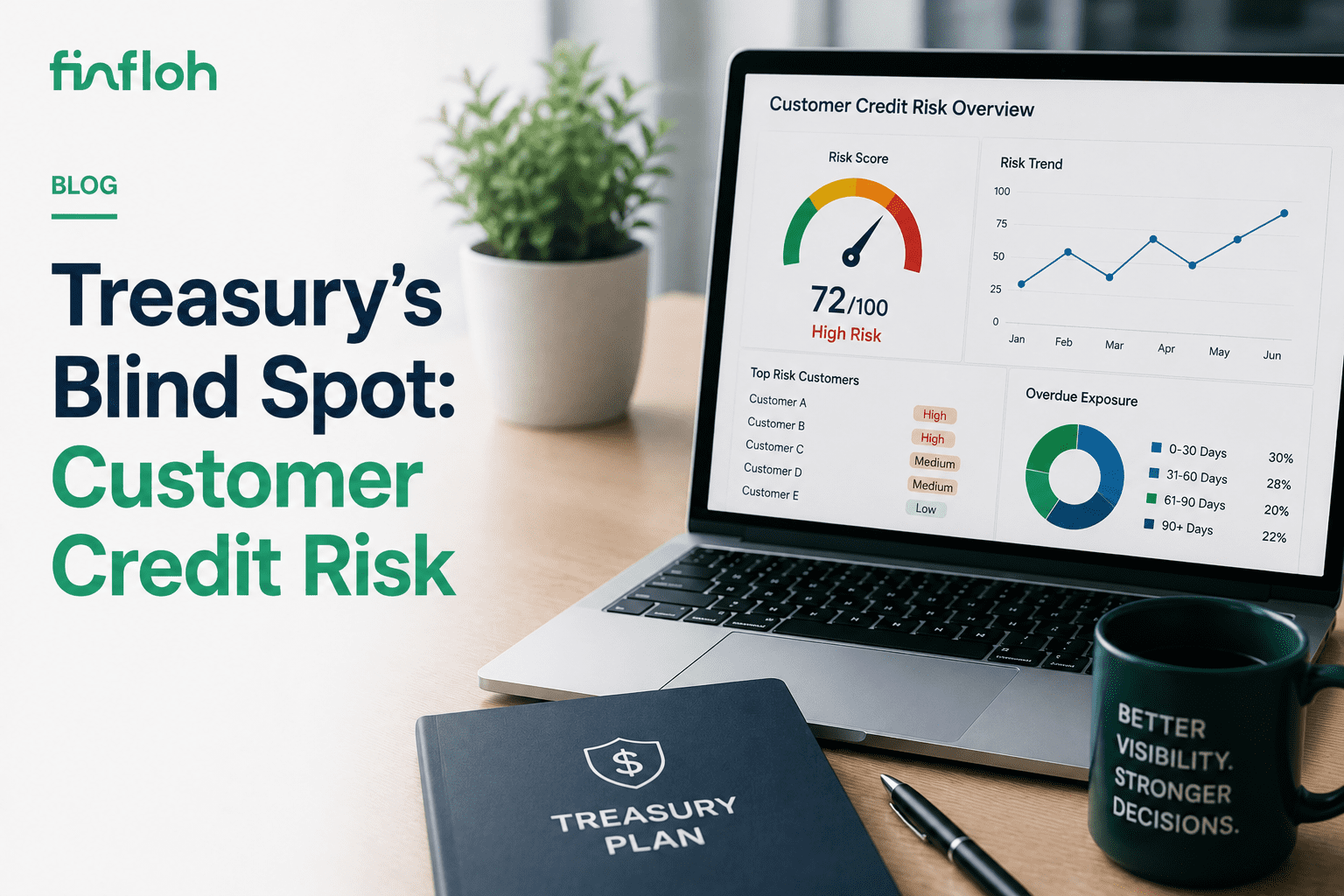

Treasury teams are responsible for managing liquidity, forecasting cash flows, optimizing working capital, and protecting financial stability. Yet many treasury functions still overlook one of the biggest variables affecting cash predictability: customer credit risk.
Most treasury models focus heavily on:
- Historical collections
- Banking positions
- Cash balances
- Funding strategies
- Market risks
But customer payment behavior, deteriorating credit quality, and receivables risk often remain outside treasury’s day-to-day visibility.
This creates a major blind spot.
In today’s uncertain economic environment, customer credit risk is no longer just a concern for credit or accounts receivable teams—it has become a critical treasury issue.
Table of Contents
What Is Customer Credit Risk?
Customer credit risk refers to the possibility that customers may:
- Delay payments
- Default on invoices
- Dispute balances
- Experience financial distress
- Fail to meet contractual payment obligations
These risks directly impact receivables realization and future cash inflows.
Why Treasury Often Overlooks Customer Credit Risk
Historically, customer credit management has been handled by:
- Credit teams
- Sales operations
- Accounts receivable departments
Treasury functions traditionally focused more on:
- Liquidity management
- Banking relationships
- Investments
- Debt and funding
As a result, treasury teams often receive only high-level receivables summaries rather than operational insights into customer payment risk.
Why This Is Becoming a Bigger Problem
Economic uncertainty, rising interest rates, supply chain disruptions, and changing customer behavior have made payment predictability more volatile.
Customers that previously paid reliably may now:
- Extend payment cycles
- Request revised terms
- Increase disputes
- Delay commitments
- Create concentration risks
Without visibility into customer risk signals, treasury forecasts become less reliable.
How Customer Credit Risk Impacts Treasury
Reduced Cash Flow Predictability
Treasury relies on expected collections to plan:
- Liquidity
- Investments
- Vendor payments
- Payroll
- Debt obligations
If customers delay or miss payments, forecast accuracy declines.
Higher Borrowing Costs
Unexpected collection delays may force businesses to:
- Draw on credit lines
- Use short-term borrowing
- Maintain larger liquidity buffers
This increases financing costs.
Liquidity Planning Challenges
Treasury teams may overestimate available cash if customer risk exposure is not reflected accurately.
Working Capital Pressure
Rising overdue receivables reduce cash conversion efficiency and strain working capital performance.
Concentration Risk Exposure
Heavy reliance on a few large customers creates treasury vulnerability if one customer faces financial distress.
The Disconnect Between AR, Credit, and Treasury
In many organizations:
- Credit teams assess customer onboarding risk
- AR teams manage collections and disputes
- Treasury forecasts liquidity independently
These disconnected workflows create fragmented visibility.
Treasury teams may not have access to:
- Customer payment trends
- Credit limit changes
- Collection delays
- Broken payment promises
- Dispute escalations
As a result, treasury forecasts may fail to reflect actual collection risks.
Why CFOs Are Connecting Treasury and Credit Visibility
Modern CFOs increasingly recognize that treasury performance depends heavily on customer payment quality.
This is driving closer integration between:
- Treasury
- Accounts receivable
- Credit management
- Collections operations
The focus is shifting from static forecasting to dynamic, risk-aware liquidity planning.
Customer Credit Risk Is More Than Default Risk
Treasury teams often associate credit risk only with customer bankruptcy or non-payment.
But the bigger operational risk is payment unpredictability.
Even customers that eventually pay can create treasury disruption through:
- Delayed payments
- Partial remittances
- Disputes and deductions
- Payment rescheduling
- Extended approval cycles
These delays impact short-term liquidity planning significantly.
The Role of AI in Customer Credit Risk Visibility
AI is helping finance teams identify emerging customer payment risks much earlier.
Behavioral Risk Analysis
AI analyzes:
- Historical payment behavior
- Invoice aging patterns
- Promise-to-pay adherence
- Dispute frequency
- Payment delays
to identify changing customer risk profiles.
Dynamic Credit Scoring
Traditional credit scores are often static and updated infrequently.
AI-driven scoring models continuously adjust risk profiles using live operational data.
Predictive Collections Forecasting
Forecasts improve when customer risk signals are integrated into cash flow models.
Early Warning Signals
AI helps identify:
- Customers likely to delay payments
- Deteriorating payment trends
- Rising dispute risks
- Collection slowdowns
before severe liquidity issues emerge.
Why Treasury Needs Real-Time Receivables Intelligence
Treasury teams increasingly require operational visibility into:
- Customer payment behavior
- Collection activity
- Credit exposure
- Dispute aging
- Payment commitments
- Overdue trends
Static monthly reports are no longer sufficient for modern liquidity management.
Treasury’s Blind Spot: Delayed Risk Recognition
Many treasury teams only recognize customer risk after:
- Payments are missed
- Forecasts fail
- Liquidity pressure increases
- Borrowing requirements rise
By then, the damage has already impacted cash flow planning.
The goal is to identify risk much earlier through connected receivables intelligence.
How FinFloh Helps Improve Customer Credit Visibility
FinFloh helps finance teams improve receivables intelligence through integrated AR, collections, and credit visibility workflows.
Real-Time Customer Payment Insights
Finance teams gain visibility into:
- Payment behavior
- Aging trends
- Collection activity
- Customer risk signals
Dynamic Credit Monitoring
Operational payment data helps identify emerging credit risks earlier.
Better Collections Forecasting
Treasury and finance teams gain more accurate visibility into expected collections and payment delays.
Integrated Dispute Visibility
Disputes and deductions are tracked centrally to reduce forecasting blind spots.
Unified Invoice-to-Cash Visibility
FinFloh connects invoicing, collections, disputes, and payment tracking into one receivables intelligence environment.
To understand how credit risk can be optimized for the best treasury operations, you can check out FinFloh Credit Hub product page. You can also Book a Demo to see how it works.
Why Treasury and AR Alignment Matters More Than Ever
The traditional separation between treasury and receivables operations is becoming increasingly risky.
Modern treasury performance depends on:
- Reliable collections
- Accurate customer risk visibility
- Dynamic forecasting
- Real-time receivables intelligence
Organizations that fail to connect treasury with customer payment risk will struggle with forecasting volatility and liquidity uncertainty.
Best Practices for Reducing Treasury Blind Spots
Integrate Treasury and AR Visibility
Ensure treasury teams have access to operational receivables data.
Monitor Customer Payment Trends Continuously
Track changes in payment behavior—not just overdue balances.
Use Dynamic Credit Models
Move beyond static annual credit reviews.
Connect Credit Risk With Forecasting
Integrate customer risk indicators into treasury forecasting models.
Improve Cross-Functional Collaboration
Align treasury, credit, collections, and AR teams around shared liquidity goals.
The Future of Treasury Is Risk-Aware
Treasury functions are evolving from reactive cash management to predictive liquidity intelligence.
This requires deeper visibility into operational finance signals, especially customer credit risk.
The organizations that connect treasury with receivables intelligence will gain:
- Better forecasting accuracy
- Stronger working capital control
- Reduced borrowing dependency
- Faster risk detection
- Greater financial resilience
Conclusion
Customer credit risk remains one of treasury’s biggest blind spots.
While treasury teams focus heavily on liquidity models and banking data, customer payment behavior often determines whether forecasted cash actually arrives on time.
As economic uncertainty increases, treasury teams need more than historical receivables reporting—they need real-time customer risk visibility.
By integrating AR, collections, credit management, and treasury workflows, businesses can improve cash predictability, strengthen liquidity planning, and reduce operational financial risk.
Modern treasury management begins with understanding the customers behind the cash flow.
