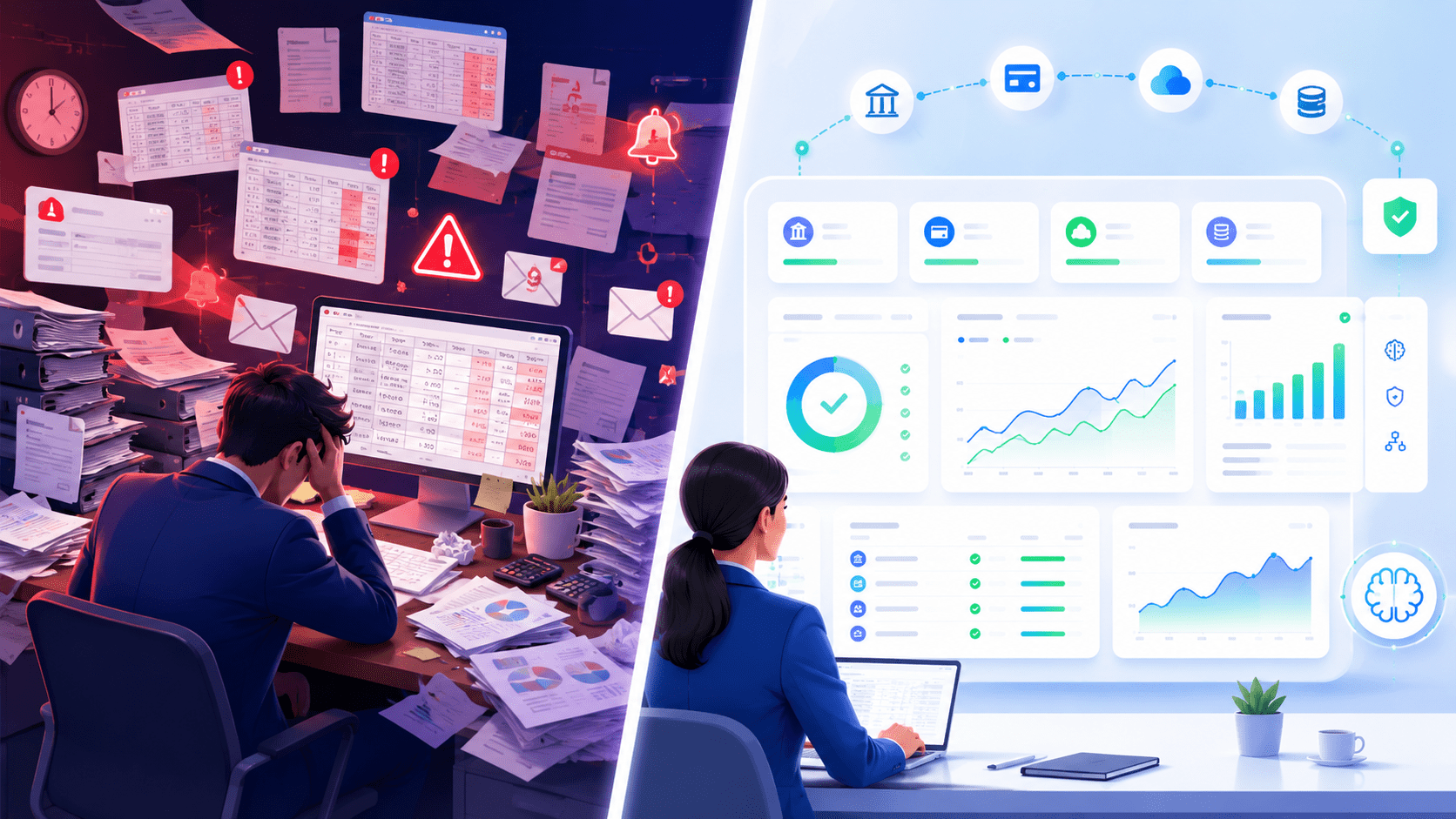

Every business records hundreds or even thousands of transactions every month — invoices, payments, refunds, bank transfers, and vendor payouts. But how do companies ensure all those numbers actually match?
That’s where Account Reconciliation comes in.
Account reconciliation is the process of comparing financial records from different sources to ensure every transaction is accurate, complete, and properly recorded. Businesses use account reconciliation to detect errors, prevent fraud, improve cash flow visibility, and maintain healthy financial operations.
Without proper account reconciliation, businesses can face duplicate payments, missing invoices, incorrect balances, compliance risks, and major reporting issues.
In today’s fast-moving finance environment, account reconciliation is no longer just an accounting task — it’s a critical part of financial control and cash flow management.
Table of Contents
What Is Account Reconciliation?
Account reconciliation is the process of comparing two sets of financial records to verify that they match.
Typically, businesses reconcile:
- Bank statements vs internal accounting records
- Customer payments vs invoices
- Vendor bills vs outgoing payments
- General ledger balances vs supporting documents
- Payment gateway transactions vs ERP records
The goal is simple:
Ensure every financial transaction is correctly recorded and accounted for.
If discrepancies appear, finance teams investigate and correct them before they become larger financial problems.
Why Does It Matter?
Even small financial mismatches can create serious operational and reporting issues over time.
1. Accurate Financial Reporting
Businesses rely on accurate numbers to make decisions. Account reconciliation ensures financial statements reflect the true financial position of the company.
Without reconciliation:
- Revenue may be overstated
- Expenses may go unrecorded
- Cash balances may become inaccurate
- Financial reports lose credibility
2. Better Cash Flow Visibility
One of the biggest benefits of account reconciliation is improved cash flow clarity.
When payments, invoices, and bank transactions align correctly, finance teams can:
- Track incoming cash accurately
- Identify delayed customer payments
- Monitor outstanding receivables
- Forecast cash flow more effectively
This helps businesses avoid unexpected cash shortages.
3. Fraud Detection & Error Prevention
Manual financial processes often create room for:
- Duplicate entries
- Unauthorized transactions
- Missing payments
- Human errors
Regular account reconciliation helps businesses identify unusual activity early before it becomes costly.
4. Faster Financial Close
Month-end closing becomes significantly easier when accounts are reconciled regularly.
Instead of spending days searching for discrepancies, finance teams can:
- Close books faster
- Improve reporting timelines
- Reduce audit stress
- Increase operational efficiency
Types of Account Reconciliation
Different types of reconciliation help businesses maintain financial accuracy across operations.
1. Bank Reconciliation
This compares:
- Company cash records
vs - Bank statements
It helps identify:
- Missing transactions
- Bank charges
- Failed payments
- Duplicate entries
2. Accounts Receivable Reconciliation
This verifies customer invoices against received payments.
Businesses use it to:
- Detect unpaid invoices
- Resolve payment mismatches
- Track outstanding balances
- Improve collections
3. Vendor Reconciliation
Vendor reconciliation ensures supplier invoices match actual payments made.
It helps prevent:
- Overpayments
- Duplicate vendor payments
- Incorrect purchase records
4. General Ledger Reconciliation
This process validates balances in the general ledger against supporting records.
It is essential for:
- Financial audits
- Compliance
- Accurate reporting

Common Challenges in Account Reconciliation
Despite its importance, many businesses still struggle with reconciliation because of manual workflows and disconnected systems.
1. Manual Data Entry Errors
Spreadsheets and manual matching increase the risk of:
- Incorrect transaction entries
- Duplicate records
- Missing data
2. High Transaction Volumes
As businesses grow, reconciliation becomes harder to manage manually.
Finance teams often deal with:
- Thousands of invoices
- Multiple bank accounts
- Payment gateways
- ERP systems
3. Delayed Payment Matching
When payments are not matched quickly:
- Cash flow visibility suffers
- Collections slow down
- Reporting becomes inaccurate
4. Lack of Real-Time Visibility
Traditional reconciliation methods often rely on outdated reports and delayed updates.
Modern finance teams need real-time reconciliation to make faster decisions.
How Automation Improves Account Reconciliation
Modern finance automation platforms simplify and accelerate the reconciliation process.
Automated account reconciliation can:
- Match transactions instantly
- Reduce manual effort
- Detect discrepancies faster
- Improve financial accuracy
- Enable real-time reporting
Automation also helps finance teams focus more on strategic decision-making instead of repetitive manual work.
Best Practices for Effective Account Reconciliation
Businesses that maintain strong reconciliation processes typically follow these best practices:
1. Reconcile Frequently
Don’t wait until month-end.
Daily or weekly reconciliation helps catch issues early.
2. Standardize Financial Processes
Consistent workflows reduce errors and improve visibility across teams.
3. Use Automation Tools
Automation minimizes manual effort and improves scalability.
4. Monitor Exceptions Proactively
Finance teams should investigate unmatched transactions immediately to avoid long-term discrepancies.
The Future of Account Reconciliation
Finance operations are becoming increasingly digital and real-time.
Modern businesses now expect:
- Automated reconciliation workflows
- AI-powered anomaly detection
- Real-time transaction visibility
- Integrated ERP and payment systems
- Predictive cash flow insights
As transaction volumes grow, automated reconciliation is quickly becoming essential rather than optional.
Conclusion
Account reconciliation is one of the most important financial control processes for any business.
It ensures financial accuracy, strengthens cash flow visibility, prevents costly errors, and supports better decision-making.
Businesses that modernize reconciliation processes with automation gain:
- Faster financial operations
- Improved cash management
- Reduced manual effort
- Better compliance
- Stronger financial confidence
In a fast-moving business environment, accurate reconciliation is critical for maintaining financial stability and operational efficiency.
About FinFloh
FinFloh helps businesses modernize accounts receivable operations with AI-powered automation, intelligent collections workflows, payment tracking, dispute management, and real-time cash flow visibility.
With FinFloh, finance teams can:
- Automate collections and follow-ups
- Improve reconciliation accuracy
- Reduce manual effort
- Accelerate cash inflows
- Gain real-time receivables insights
FinFloh enables businesses to build faster, smarter, and more efficient finance operations.
Talk to Our Experts if you are looking to simplify reconciliation and improve cash flow visibility or book a Demo to see how automated AR workflows and real-time payment visibility can help your finance team work smarter.
