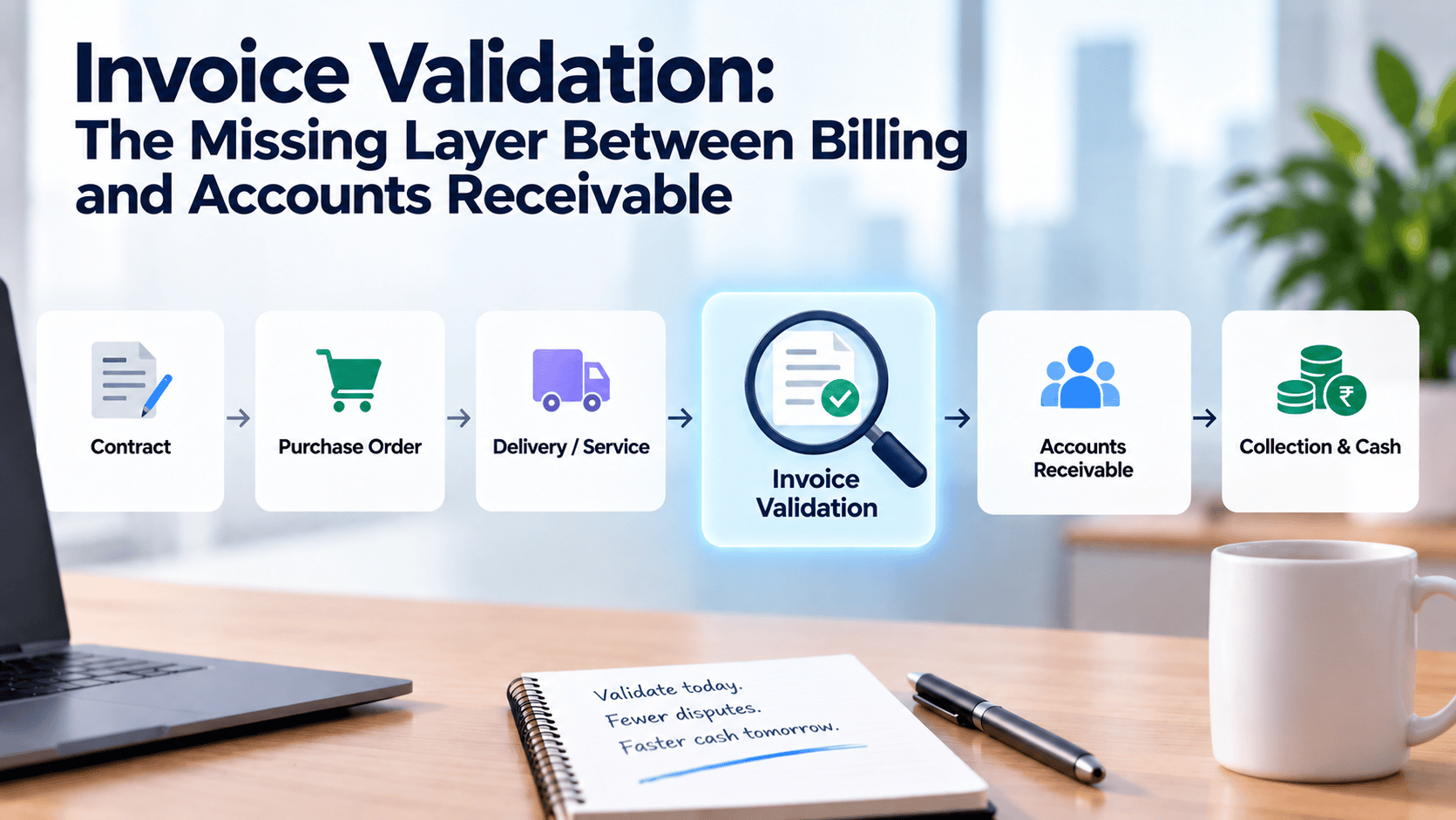

Invoice generation is often treated as the final step of the billing process.
The invoice is created in the ERP, accounting validations are completed, and the invoice is sent to the customer.
From there, the Accounts Receivable team takes over.
But there is an important layer missing in many finance processes:
Is the invoice actually correct before it enters the customer’s payment process?
An invoice can be generated successfully and still contain an incorrect price, quantity, discount, billing period, PO reference, or supporting document.
When that happens, the problem often appears later as an AR dispute.
By then, the invoice has already moved downstream.
This is why invoice validation sits between billing and Accounts Receivable.
Table of Contents
What Is Invoice Validation?
Invoice validation is the process of checking whether an invoice accurately reflects the underlying commercial transaction before it is sent to the customer.
It goes beyond checking whether an invoice can be created in the ERP.
A comprehensive validation process can compare the invoice against:
- Customer contract
- Purchase order
- Delivery or service records
- Pricing agreements
- Customer-specific requirements
- Contract amendments
- Supporting documents
- Billing rules
The objective is to answer a simple question:
Is this invoice ready to be sent to the customer?
Billing and AR Solve Different Problems
Billing and Accounts Receivable have different responsibilities.
1. Billing
It is primarily concerned with creating the invoice.
It answers:
- What should be invoiced?
- At what price?
- For what quantity?
- For which period?
- To which customer?
Accounts Receivable
AR is primarily concerned with what happens after invoicing.
It answers:
- Has the customer received the invoice?
- Is the invoice due?
- Has the customer paid?
- Is the invoice overdue?
- Is there a dispute?
- What needs to be collected?
Invoice validation sits between these two functions.
It asks:
Before AR has to collect the money, is there anything wrong with the invoice itself?
The Missing Layer
A typical invoice-to-cash process looks like:
Contract → Billing → Invoice → AR → Collection → Cash
But there is an important control point between billing and AR:
Contract → Billing → Invoice → Validation → AR → Collection → Cash
That validation layer can prevent issues from moving downstream.
Without it:
Incorrect invoice → Customer dispute → AR investigation → Payment delay
With it:
Invoice → Validation → Exception identified → Correction → Customer invoice
The earlier an error is identified, the less likely it is to become an AR problem.
Why ERP Validation Is Not Enough
ERPs perform essential invoice validations.
They may check:
- Customer exists
- Item or service exists
- Tax code is valid
- Accounting combination is valid
- Required fields are populated
- Invoice totals calculate correctly
- Currency is valid
- Invoice can be posted
These checks are important.
But many commercial validation questions require information outside the ERP.
For example:
Does the invoice price match the customer contract?
Does the quantity match the customer’s PO?
Was the service actually delivered?
Was the latest contract amendment applied?
Does the customer require a specific supporting document?
An invoice can pass ERP validation and still fail these checks.
Where Invoice Errors Come From
1. Pricing Differences
A customer may have negotiated pricing that differs from the standard ERP price.
For example:
ERP price: ₹1,000
Contract price: ₹950
The invoice may be generated correctly using the ERP’s configured price but still conflict with the customer’s commercial agreement.
2. Quantity Differences
The invoice may contain 1,000 units while the customer PO or delivery record supports only 950.
The calculation is correct.
The quantity is not.
3. Discount Errors
A contract may provide a volume discount, customer-specific discount, or promotional rate.
If the applicable discount is not reflected in the invoice, the customer may dispute the amount.
4. Contract Amendments
The customer may have amended the contract from ₹10 lakh per month to ₹12 lakh.
If the billing system continues using the original terms, invoices can become outdated even though the ERP considers them valid.
5. Billing Period Errors
An invoice may be generated for the wrong period.
For example, a monthly service could be billed before the relevant service period or duplicated for a period already invoiced.
6. Missing Supporting Documents
Some customers require:
- Purchase orders
- Delivery notes
- Timesheets
- Service acceptance certificates
- Milestone approvals
- Proof of delivery
The invoice may be financially accurate but still fail the customer’s AP process without the required documentation.
Invoice Validation Is About Context
The invoice itself rarely contains all the information required to determine whether it is correct.
Consider a simple invoice:
Quantity: 1,000
Price: ₹500
Total: ₹5 lakh
The arithmetic is straightforward.
But finance still needs to know:
- Was 1,000 units ordered?
- Were 1,000 units delivered?
- Was ₹500 the agreed price?
- Was a discount applicable?
- Was this quantity already invoiced?
- Was the customer entitled to a different price under an amendment?
The invoice becomes meaningful only when viewed in the context of the underlying transaction.
The Four-Way Validation Model
A useful way to think about invoice validation is to connect four sources of information:
Contract
What was commercially agreed?
Purchase Order
What did the customer authorize?
Delivery / Service
Delivery
Invoice
What are we asking the customer to pay?
The validation process looks for inconsistencies between them.
| Comparison | What it validates |
|---|---|
| Contract vs Invoice | Pricing and commercial terms |
| PO vs Invoice | Ordered quantity, price and scope |
| Delivery vs Invoice | Actual quantity or service delivered |
| Contract vs PO | Whether the customer’s order reflects agreed terms |
Not every transaction requires every comparison.
But together, these sources create a stronger validation framework.
Why This Matters to Accounts Receivable
Invoice validation is not just a billing control.
It directly affects AR performance.
Consider the typical chain:
Incorrect invoice
↓
Customer rejects invoice
↓
Dispute created
↓
AR investigates
↓
Credit note / corrected invoice
↓
Invoice resubmitted
↓
Payment delayed
A single billing error can create work for:
- Billing
- Finance
- AR
- Sales
- Operations
- Customer service
It can also increase outstanding receivables and lead to cash realization delays.
Invoice Validation Can Reduce Avoidable Disputes
Not every customer dispute is caused by an incorrect invoice.
Some disputes arise from genuine commercial disagreements or customer-side issues.
But a meaningful portion of invoice-related exceptions can originate from preventable discrepancies such as:
- Incorrect pricing
- Incorrect quantity
- Missing PO references
- Incorrect billing period
- Missing documentation
- Contract terms not reflected
- Incorrect discounts
- Unapplied amendments
Identifying these issues before the invoice is sent gives finance an opportunity to resolve them upstream.
From Reactive AR to Preventive Finance
Traditional AR processes often identify problems after the invoice reaches the customer.
The workflow becomes:
Invoice → Customer rejection → Dispute → Investigation → Resolution
Where Invoice validation changes the timing:
Invoice → Validation → Exception → Correction → Invoice
This does not eliminate the need for AR.
Instead, it allows AR teams to focus more of their time on genuine collection activities rather than resolving preventable invoice problems.
How AI Can Strengthen Invoice Validation
Manual validation becomes difficult when finance teams handle large invoice volumes or complex customer contracts.
AI can help interpret and compare information across different sources.
For example, it can identify:
- Contract price vs invoice price
- PO quantity vs invoice quantity
- Delivery quantity vs invoice quantity
- Applicable discounts
- Billing-period inconsistencies
- Contract amendments
- Missing references
- Missing supporting documents
- Customer-specific requirements
Instead of requiring finance teams to manually inspect every invoice, AI can identify exceptions that require attention.
The model becomes:
Automate routine checks → Identify exceptions → Route exceptions for review
Exception-Based Invoice Validation
The objective should not necessarily be to manually validate every invoice.
A better approach is to identify invoices where something does not align.
For example:
Invoice matches contract, PO and delivery
→ No exception
Invoice price differs from contract
→ Pricing exception
Invoice quantity exceeds delivered quantity
→ Quantity exception
Required supporting document missing
→ Documentation exception
Contract amendment not reflected
→ Contract exception
This allows finance teams to focus their effort where it matters most.
How FinFloh Helps
FinFloh helps bring together information across the invoice-to-cash process, including customer, invoice, contract, receivables, disputes, and collections data.
Its invoice validation capabilities can help finance teams identify discrepancies before invoices become customer-facing problems.
This can include:
- Comparing invoices against contractual terms
- Validating pricing and discounts
- Checking quantities against available transaction or delivery information
- Identifying contract amendments
- Detecting missing invoice information
- Checking customer-specific requirements
- Identifying potential billing exceptions
- Routing exceptions for finance review
The objective is to move invoice validation upstream of Accounts Receivable.
Instead of asking AR to fix an invoice after a customer dispute, finance can identify the problem before the invoice reaches the customer.
Best Practices for Invoice Validation
1. Validate Before Sending
The most valuable time to identify an invoice problem is before the customer receives it.
2. Go Beyond ERP Checks
ERP validation should remain the foundation, but commercial validation requires additional context.
3. Connect Contracts and POs
Pricing and commercial terms should be available during invoice validation.
4. Include Delivery or Service Data
Where relevant, compare invoiced quantities with what was actually delivered.
5. Track Amendments
Always validate against the latest applicable commercial terms.
6. Focus on Exceptions
Use automation to identify discrepancies rather than relying entirely on manual review.
7. Measure the AR Impact
Track whether invoice validation reduces disputes, credit notes, invoice reissuance, and payment delays.
Conclusion
Invoice validation is the missing control layer between billing and Accounts Receivable.
Billing creates the invoice.
AR manages the receivable.
But before the invoice reaches the customer, finance needs to know whether it accurately represents the commercial transaction.
That requires looking beyond the ERP and connecting:
Contract → PO → Delivery / Service → Invoice
When these sources are validated together, finance can identify errors before they become disputes.
The goal is not simply to generate invoices faster.
It is to send invoices that are correct the first time — so AR can focus on collecting cash rather than fixing billing problems.
