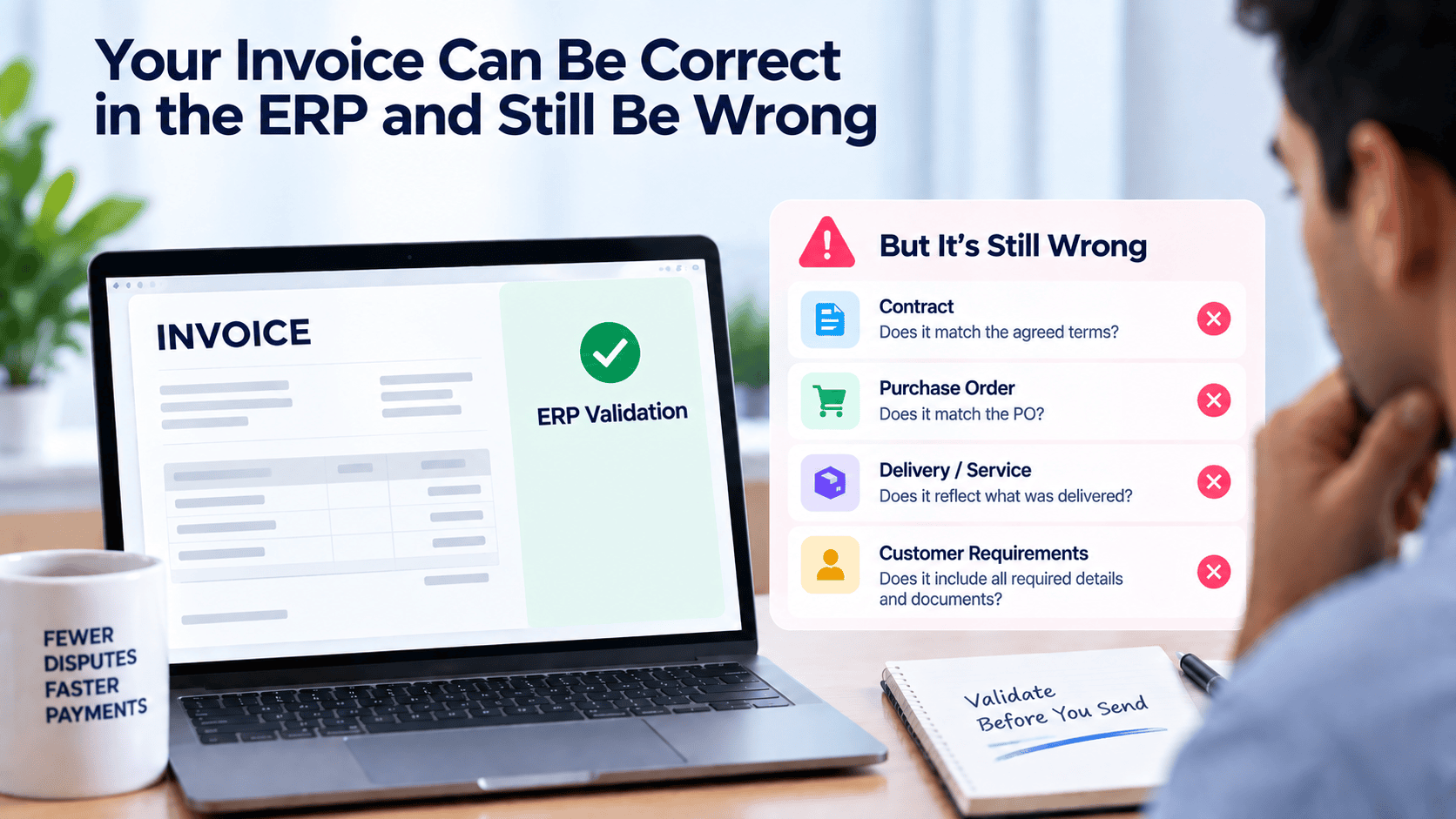

An invoice can pass every validation check inside an ERP and still be incorrect from a business perspective.
The invoice may have a valid customer code, a valid tax code, a valid accounting combination, and a mathematically correct total. It may post successfully into the ERP without generating a single system error.
And yet, the customer may dispute it.
Why?
Because ERP validation and invoice validation are not always the same thing.
An ERP can confirm that an invoice is technically valid. It may not always confirm that the invoice reflects what was actually agreed with the customer.
For finance teams, this distinction is important.
The real question is not simply:
“Can this invoice be posted?”
It is:
“Is this invoice correct based on the contract, purchase order, delivery, pricing, and customer-specific requirements?”
Table of Contents
What Does It Mean for an Invoice to Be “Correct”?
There are several different dimensions of invoice correctness.
An invoice can be:
- System-correct — it passes ERP validation
- Mathematically correct — quantities, rates, taxes, and totals calculate correctly
- Contractually correct — it reflects the agreed commercial terms
- PO-correct — it matches the customer’s purchase order
- Operationally correct — the goods or services were actually delivered
- Customer-process correct — it contains the information and documentation required by the customer
These are not necessarily the same thing.
An ERP may validate the first two while the remaining checks require information from contracts, POs, delivery records, customer master data, or supporting documents.
How an Invoice Can Be Correct in the ERP but Wrong for the Customer
Consider a simple example.
A company has a contract with a customer for:
₹1,000 per unit
The customer has a valid PO for:
10,000 units at ₹950 per unit
The ERP contains a valid customer, product, tax code, and price of ₹1,000.
The invoice is generated for:
10,000 × ₹1,000 = ₹1 crore
The ERP accepts the invoice.
From the ERP’s perspective, nothing may be wrong.
But from the customer’s perspective, the invoice does not match the PO.
The customer may reject or dispute the invoice.
This is the fundamental difference between:
“Is the invoice valid in the system?”
and
“Is the invoice valid for the transaction?”
Where Invoice Validation Actually Gets Complicated
Invoice validation becomes difficult when the information needed to validate an invoice exists outside the ERP.
A typical transaction may involve:
Contract → Purchase Order → Delivery / Service → Invoice → Payment
Each stage contains information that can affect whether the invoice is correct.
For example:
- The contract defines the agreed price
- The PO defines the customer’s approved quantity and commercial terms
- Delivery records confirm what was actually delivered
- The invoice represents what the company is asking the customer to pay
- Customer requirements determine what documentation must accompany the invoice
If these sources are not connected, finance teams may validate the invoice against only a subset of the available information.
1. Pricing Can Be Wrong Even When the ERP Price Is Valid
Pricing is one of the most common sources of invoice discrepancies.
A customer may have:
- Contract-specific pricing
- Volume discounts
- Promotional pricing
- Customer-specific rebates
- Tiered pricing
- Temporary pricing
- Renewal-based price changes
- Special project rates
The ERP may contain a valid price.
But valid price does not necessarily mean correct price for this transaction.
For example:
ERP price: ₹500
Contract price: ₹475
Invoice price: ₹500
The invoice can be generated successfully while still creating a commercial discrepancy.
2. Quantity Can Be Wrong
An invoice may contain a valid product and a valid price but still have an incorrect quantity.
For example:
PO quantity: 1,000 units
Delivered quantity: 950 units
Invoice quantity: 1,000 units
The invoice may calculate correctly:
1,000 × ₹500 = ₹5 lakh
But if only 950 units were delivered, the invoice may not reflect the underlying transaction.
Quantity validation therefore often requires connecting billing with operational or delivery data.
3. Billing the Right Customer at the Wrong Time
Billing timing can also be governed by the contract.
A customer may be billed:
- Monthly
- Quarterly
- Annually
- On delivery
- On milestone completion
- After customer acceptance
- Based on usage
- After a specified service period
An invoice can contain the correct amount but still be premature.
For example, a contract may state:
50% of the project fee becomes billable after completion and customer acceptance of the implementation milestone.
If the invoice is generated before acceptance, the amount may be mathematically correct but commercially premature.
4. Discounts Can Be Applied Incorrectly
Discounts are another area where ERP validation may not be sufficient.
Consider a contract that provides:
5% discount for monthly purchases above ₹50 lakh
The customer purchases ₹60 lakh of products.
The invoice is generated without the discount.
The invoice may contain valid prices and quantities, but the customer may dispute the amount because the contractual pricing condition was not applied.
The opposite can also happen.
A discount may be applied even though the customer did not meet the required condition.
Both situations require more than basic ERP validation.
5. Contract Amendments Can Create Invoice Errors
Customer contracts change.
A contract may be amended to change:
- Price
- Quantity
- Scope
- Billing frequency
- Payment terms
- Discounts
- Service dates
- Minimum commitments
Consider:
Original price: ₹10 lakh/month
Amended price: ₹12 lakh/month from July 1
If the ERP continues using ₹10 lakh, the invoice may still be perfectly valid from a system perspective.
But it no longer reflects the latest commercial agreement.
This is one reason invoice validation cannot always stop at ERP data.
6. Purchase Order Requirements Matter
Some customers operate strict PO-based procurement processes.
They may require:
- Exact PO number
- Specific PO line reference
- Matching quantity
- Matching price
- Correct legal entity
- Correct billing address
- Specific tax information
- Supporting documents
- Particular invoice format
An invoice can be internally correct and still be rejected because it does not meet the customer’s invoicing requirements.
That rejection can delay payment even when the underlying amount is undisputed.
7. Supporting Documents Can Determine Whether an Invoice Is Payable
Some invoices depend on supporting documentation.
Examples include:
- Proof of delivery
- Timesheets
- Work completion certificates
- Service acceptance documents
- Delivery notes
- Milestone approvals
- Purchase orders
- Contract references
The invoice amount may be correct, but the customer may not process it without the required evidence.
This creates an important distinction:
Invoice correctness ≠ invoice readiness for payment
An invoice can be financially accurate but operationally incomplete.
8. Tax and Accounting Validation Is Only One Layer
ERP systems are particularly effective at validating structured financial information.
They can validate things such as:
- Tax codes
- Currency
- Customer accounts
- Accounting combinations
- Mandatory fields
- Invoice numbering
- Calculation logic
- Posting rules
These checks are essential.
But they answer questions such as:
“Can this transaction be recorded correctly?”
Invoice validation needs to answer an additional question:
“Does this transaction accurately represent the underlying commercial agreement?”
The Four-Way View of Invoice Validation
A stronger invoice validation process can bring together four important sources:
Contract
What was commercially agreed?
Purchase Order
What did the customer formally authorize?
Delivery / Service Data
What was actually delivered?
Invoice
What are we asking the customer to pay?
The objective is to identify whether these four elements are aligned.
For example:
| Validation | Question |
|---|---|
| Contract vs Invoice | Is the price and commercial structure correct? |
| PO vs Invoice | Does the invoice match what the customer ordered? |
| Delivery vs Invoice | Are we billing for what was actually delivered? |
| Contract vs PO | Does the customer’s PO reflect the agreed commercial terms? |
This provides a much stronger validation layer than checking the invoice against ERP master data alone.
Why Manual Invoice Validation Doesn’t Scale
Finance teams often perform these checks manually.
An analyst may need to:
- Open the invoice
- Find the customer contract
- Locate the relevant pricing clause
- Find the purchase order
- Check the PO quantity
- Review delivery information
- Verify discounts
- Check supporting documents
- Compare payment terms
- Decide whether the invoice is ready to send
This becomes increasingly difficult as invoice volumes increase.
It is particularly challenging when contracts are long, customer-specific, or frequently amended.
How AI Can Improve Invoice Validation
AI can help connect information that traditionally exists in different documents and systems.
Instead of simply reading the invoice, AI can evaluate the invoice in context.
It can help identify:
- Contracted price vs invoice price
- PO price vs invoice price
- Contracted quantity vs invoice quantity
- PO quantity vs invoice quantity
- Applicable discounts
- Billing period
- Contract amendments
- Missing PO references
- Missing supporting documents
- Customer-specific invoice requirements
- Potential duplicate invoices
- Exceptions requiring human review
The objective is not to replace the ERP’s validation.
It is to add a commercial validation layer around it.
From Invoice Validation to Exception Management
Not every invoice needs the same level of manual review.
A better approach is to identify exceptions.
For example:
i. Invoice matches contract + PO + delivery → Low-risk invoice
ii. Invoice price differs from contract → Review required
iii. Invoice quantity exceeds delivered quantity → Review required
Required supporting document missing → Review required
Contract amendment not reflected in invoice → Review required
This allows finance teams to focus their attention on invoices where something does not align.
Why This Matters for Accounts Receivable
Invoice validation is often treated as a billing problem.
But it directly affects AR.
An incorrect invoice can lead to:
Incorrect invoice → Customer dispute → Payment delay → Higher outstanding AR → Longer DSO
In many cases, the collection team is left trying to resolve an issue that originated before the invoice was even sent.
Better invoice validation moves the problem upstream.
Instead of asking the collections team to resolve a dispute after the invoice is rejected, finance can identify the potential issue before the invoice reaches the customer.
How FinFloh Helps
FinFloh’s invoice validation capabilities are designed to help finance teams validate invoices against the broader commercial context.
This can include information from:
- Customer contracts
- Purchase orders
- Invoice data
- Delivery or service information
- Customer-specific requirements
- Supporting documents
AI can help identify discrepancies across these sources and surface exceptions for finance teams to review.
The objective is simple:
Send the right invoice the first time.
That can help reduce avoidable disputes, improve invoice acceptance, and prevent billing errors from becoming collection problems.
To know more about how FinFloh could help in invoice validation, you can check out FinFloh Invoice Validation product page.
Best Practices for Invoice Validation
1. Validate More Than ERP Fields
ERP validation should be the foundation, not the entire validation process.
2. Connect Contracts and POs
Commercial terms should be available when invoices are validated.
3. Validate Quantities Against Delivery
Where relevant, compare invoiced quantities with actual delivery or service records.
4. Track Contract Amendments
Always validate against the latest applicable commercial terms.
5. Check Customer-Specific Requirements
A technically correct invoice may still be rejected if it does not meet the customer’s invoicing process.
6. Use Exception-Based Review
Automate routine validation and focus human attention on discrepancies.
7. Measure Downstream Impact
Track whether improved invoice validation leads to fewer disputes, faster invoice acceptance, and fewer payment delays.
Conclusion
An invoice can be correct in the ERP and still be wrong for the customer.
ERP validation answers whether an invoice can be processed within the system.
True invoice validation asks whether the invoice reflects:
What was agreed → What was ordered → What was delivered → What should be billed
That requires looking beyond the invoice itself.
For finance teams, AI can provide an additional layer of intelligence by connecting contracts, POs, delivery information, and invoices to identify discrepancies before they become disputes.
The goal is not simply to generate invoices that the ERP accepts.
It is to generate invoices that the customer can accept too.
