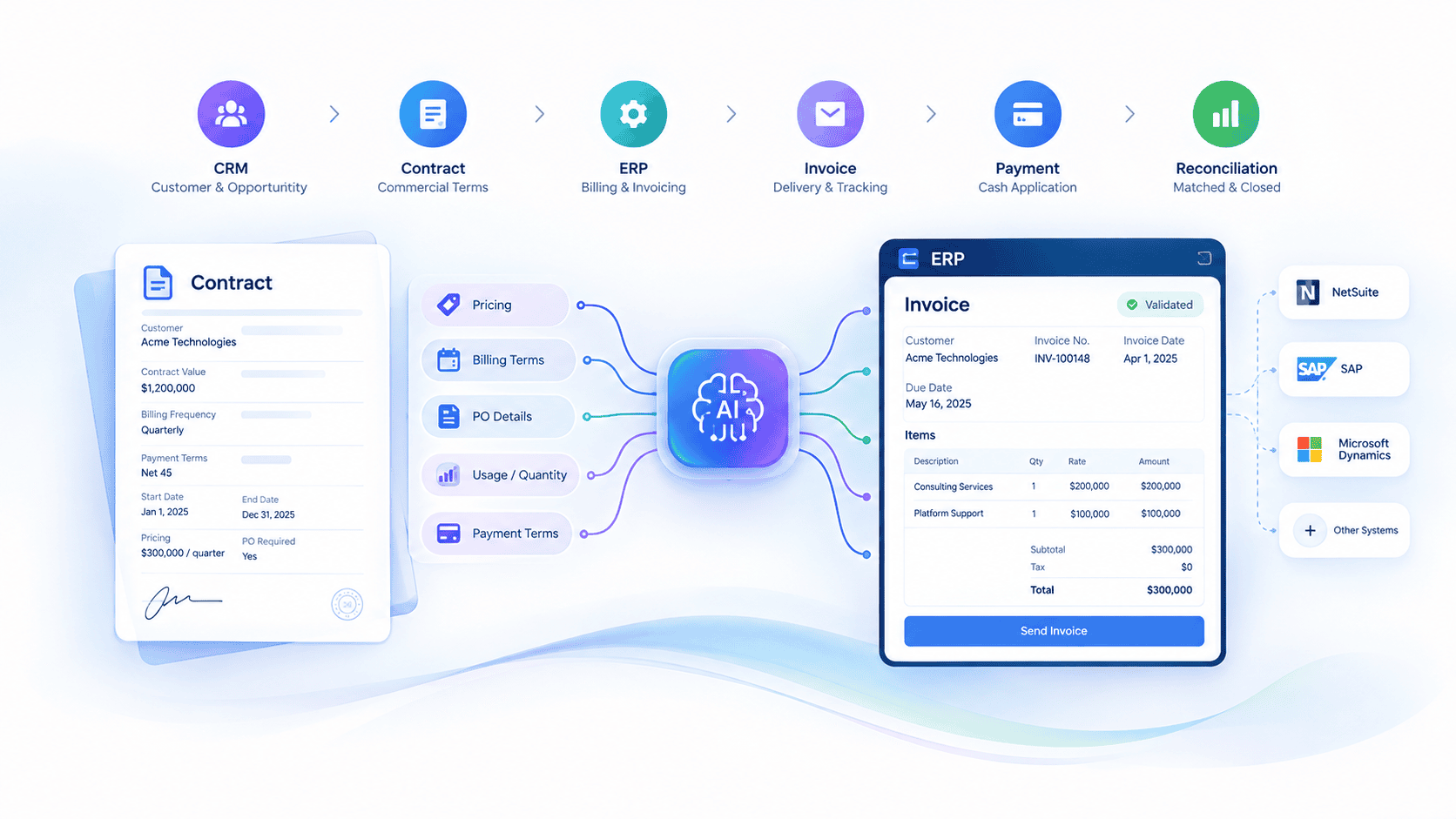

Your ERP knows almost everything about an invoice. But effective ERP contract management goes a step further by connecting invoice data with the commercial terms that created it.
It knows when an invoice was created, who it was sent to, how much is due, when it is overdue, and whether the payment has been received.
But there is a bigger question finance teams should be asking:
Table of Contents
Does your ERP know why that invoice exists in the first place?
That answer is often less clear.
The contract sits in one place. The CRM has the customer and deal information. Timesheets may live somewhere else. Billing teams work with spreadsheets. And the ERP eventually receives the information needed to create the invoice.
By the time an invoice reaches the customer, the connection between the contract and the invoice can be surprisingly fragile.
This is where better ERP contract management can make a difference.
The contract is where the billing story begins
An invoice is not an isolated financial document.
It is the outcome of everything that happened before it.
A customer may have signed a contract that specifies:
- A fixed monthly fee
- Usage-based billing
- Minimum commitments
- Milestone-based payments
- Different rates for different services
- Specific billing dates
- Payment terms
- Discounts
- Taxes
- Currency
- Renewal or termination conditions
- Purchase order requirements
- Service credits or penalties
The invoice needs to reflect those commercial terms accurately.
But in many businesses, the ERP doesn’t actually “understand” the contract. It simply receives billing information from another system or from a person.
And that creates a gap.
Where the contract-to-invoice gap starts?
Imagine a B2B technology company signs a ₹1 crore annual contract with a customer.
The agreement says the customer will be billed quarterly, with different pricing for different services.
The sales team records the opportunity in the CRM.
The legal team stores the signed agreement.
The delivery team tracks usage or timesheets.
The finance team receives the information required for billing.
And the ERP generates the invoice.
On paper, everything looks connected.
In reality, there may be several manual handoffs in between.
A billing executive might refer to an Excel sheet. Someone might manually check the contract PDF. Another person might confirm the customer’s PO number over email.
One missed clause can result in an incorrect invoice.
And once that invoice reaches the customer, the problem becomes a dispute.
The invoice may be correct according to the ERP
This is an important distinction.
Your ERP can tell you that the invoice was generated correctly according to the data it received.
But that doesn’t necessarily mean the invoice was correct according to the contract.
That’s the real problem.
The ERP is often very good at processing financial transactions.
It isn’t necessarily designed to interpret the commercial agreement behind those transactions.
What happens when contracts and invoices aren’t connected?
The consequences usually show up somewhere else in the finance function.
1. Billing errors
A rate from an old contract version gets used.
A discount is missed.
A billing frequency changes but the invoice template doesn’t.
A milestone isn’t captured correctly.
These may seem like small mistakes individually. Across hundreds or thousands of invoices, they become expensive.
2. Revenue leakage
Revenue leakage doesn’t always come from fraud or major accounting errors.
Sometimes it is much simpler.
A contract allows a certain charge, but nobody remembers to bill it.
A price increase takes effect, but the billing system continues using the previous rate.
A customer exceeds a contracted threshold, but the additional usage isn’t invoiced.
The money was contractually earned.
It simply wasn’t captured.
3. More disputes
Customers often dispute invoices because something doesn’t match their expectations.
The customer’s finance team might say:
“That’s not what our contract says.”
Now your collections team has to investigate.
Someone searches for the agreement.
Who checked the CRM.
Did they look at the previous invoice.
Someone asks the account manager.
A simple billing question turns into a cross-functional investigation.
4. Slower collections
An invoice under dispute is rarely paid on time.
The collections team can send reminders every few days, but reminders won’t solve a contract discrepancy.
If the underlying issue isn’t resolved, the invoice continues aging.
That’s how a billing problem becomes a cash-flow problem.
ERP contract management can close the missing link
The goal isn’t necessarily to replace your ERP.
In fact, most finance teams don’t want another system that forces them to rip out their existing infrastructure.
The better approach is to create an intelligent layer that connects the systems already being used.
Your ERP can continue handling financial transactions, while the CRM manages customer and sales information. Contracts can remain in your existing repository, without forcing finance teams to move everything into another system.
The goal isn’t to replace these systems. It’s to connect them, so the right commercial context flows between them when finance teams need it.
But an automation layer can understand the relationship between them.
That’s where ERP contract management becomes much more valuable.
From contract to invoice: what should actually happen?
A modern contract-to-cash workflow should look something like this:
Contract → Commercial Terms → Customer/Opportunity → Billing Rules → Invoice → Collections → Payment → Reconciliation
Instead of treating each step as a separate activity, finance teams can connect them into one continuous process.
Step 1: Read the contract
AI can extract relevant commercial information from contracts, amendments and supporting documents.
For example:
- Contract value
- Billing frequency
- Start and end dates
- Payment terms
- Pricing structure
- PO requirements
- Usage commitments
- Milestones
- Discounts
- Renewal conditions
Step 2: Convert terms into billing logic
The extracted information needs to become something finance systems can actually use.
For example:
Contract says: ₹10 lakh per quarter, payable within 45 days.
The system should understand:
Billing: ₹10 lakh
Frequency: Quarterly
Credit period: 45 days
This removes the need for someone to repeatedly interpret the same contract manually.
Step 3: Validate before invoicing
Before the invoice is generated, the system can compare the proposed billing information against the commercial terms.
It can flag questions such as:
- Does the rate match the contract?
- Is the billing period correct?
- Has the contract expired?
- Is the PO valid?
- Is a discount applicable?
- Does the invoice reflect the latest amendment?
- Are usage or timesheet quantities consistent?
Instead of discovering these issues after the invoice reaches the customer, finance teams can catch them beforehand.
Step 4: Generate and deliver the invoice
Once the invoice passes validation, it can move through the existing ERP and billing workflow.
The invoice can then be automatically delivered to the right customer contacts, with tracking around delivery, opening and engagement.
Step 5: Continue the loop into collections
This is where the value becomes even bigger.
The contract shouldn’t disappear from the process once the invoice is generated.
Collections teams should have context around:
What was agreed → What was billed → What was paid → What is disputed → What is still due
That gives finance teams a much clearer picture of the customer relationship.
Your ERP doesn’t need to become your contract repository
There is a common misconception that better ERP contract management means forcing contracts into the ERP.
It doesn’t.
The real objective is context.
Your ERP should be able to work with the relevant information from the contract without requiring finance teams to manually search through documents every time something goes wrong.
Think of it this way:
Your ERP is the financial system of record.
Your contract is the commercial source of truth.
The missing layer is the intelligence that connects the two.
AI makes this connection more practical
Historically, connecting contracts to invoices required a lot of manual configuration.
Historically, connecting contracts to invoices required a lot of manual work. Finance teams first had to read the agreement, identify the relevant billing terms, enter them into the appropriate systems, and then keep those details updated whenever the contract changed.
That process becomes increasingly difficult as contract volumes grow. A single pricing change, renewal clause, billing condition, or amendment can easily get missed, creating downstream billing errors and disputes.
AI changes the economics of that process.
An AI system can read contracts, identify relevant clauses, compare them with billing information and surface exceptions for human review.
The important part isn’t simply “AI reads contracts.”
The real value is what happens after it reads them.
AI should answer finance questions such as:
“Why is this invoice different from the contract?”
“Which invoices use outdated rates??”
“How many customers have contractual price increases coming up?”
“Which invoices are likely to face disputes?”
“Are we billing everything we’re entitled to bill?”
Those are much more useful questions than simply asking AI to summarise a PDF.
What finance teams gain from connecting contracts and invoices?
When contract intelligence becomes part of the billing workflow, the impact extends beyond invoice automation.
1. Fewer billing errors
The system validates invoices against the underlying commercial terms before sending them to the customer.
2. Faster dispute resolution
Finance teams can quickly identify whether an issue is genuinely a billing error or a misunderstanding of the contract.
3. Better revenue capture
Contractual charges, renewals and pricing changes are less likely to fall through manual processes.
4. Shorter collection cycles
Fewer invoice disputes mean fewer invoices get stuck in the collections process.
5. Better visibility for CFOs
Instead of looking at invoices as isolated transactions, finance leaders can see the entire journey from commercial agreement to cash realization.
The bigger opportunity: connecting the entire Contract-to-Cash cycle
The contract-invoice connection is only one part of the problem.
For many B2B businesses, the bigger challenge is dealing with the fragmented processes in Contract-to-Cash process.
Sales owns the opportunity.
Legal owns the contract.
Operations owns delivery.
Finance owns billing.
AR owns collections.
Treasury owns reconciliation.
Each team has a piece of the story.
But cash doesn’t care about organizational boundaries.
If one part of the process breaks, the impact eventually appears in cash flow.

The opportunity is to create a connected flow where information moves from the original commercial agreement all the way through to payment and reconciliation.
What this could look like with FinFloh?
FinFloh acts as an intelligent automation layer across the existing finance stack.
Instead of replacing your ERP, CRM or other business systems, FinFloh connects the information between them and automates the processes around Contract-to-Cash and Accounts Receivable.
With DocSense AI, FinFloh reads contracts and business documents to identify important commercial terms.
Finance teams can then use this information across invoicing, validation, collections, and downstream AR workflows.
With FlohSense AI, customer communications can also become part of the financial context — helping teams identify payment intent, disputes, remittance information and potential escalation risks from customer conversations.
The result is a more connected flow:
Contract → Billing → Invoice → Customer Communication → Collections → Payment → Reconciliation
Instead of asking finance teams to manually connect the dots.
About FinFloh
FinFloh is an AI-native Contract-to-Cash and Accounts Receivable automation platform built for B2B finance teams.
FinFloh connects your existing ERP, CRM, banking, communication and business systems through an intelligent automation layer to help finance teams streamline invoicing, collections, cash application, reconciliation, dispute management and credit risk.
With DocSense AI for document and contract intelligence and FlohSense AI for customer communication and AR intelligence, FinFloh helps businesses connect the dots between what was agreed, what was billed and what was ultimately collected.
Whether you’re running NetSuite, SAP, Microsoft Dynamics or another ERP, FinFloh helps bring greater intelligence and automation to your existing finance infrastructure.
Want to make your Contract-to-Cash process smarter?
Talk to our experts or Book a Demo to explore how FinFloh can connect your contracts, billing, collections and reconciliation workflows.
