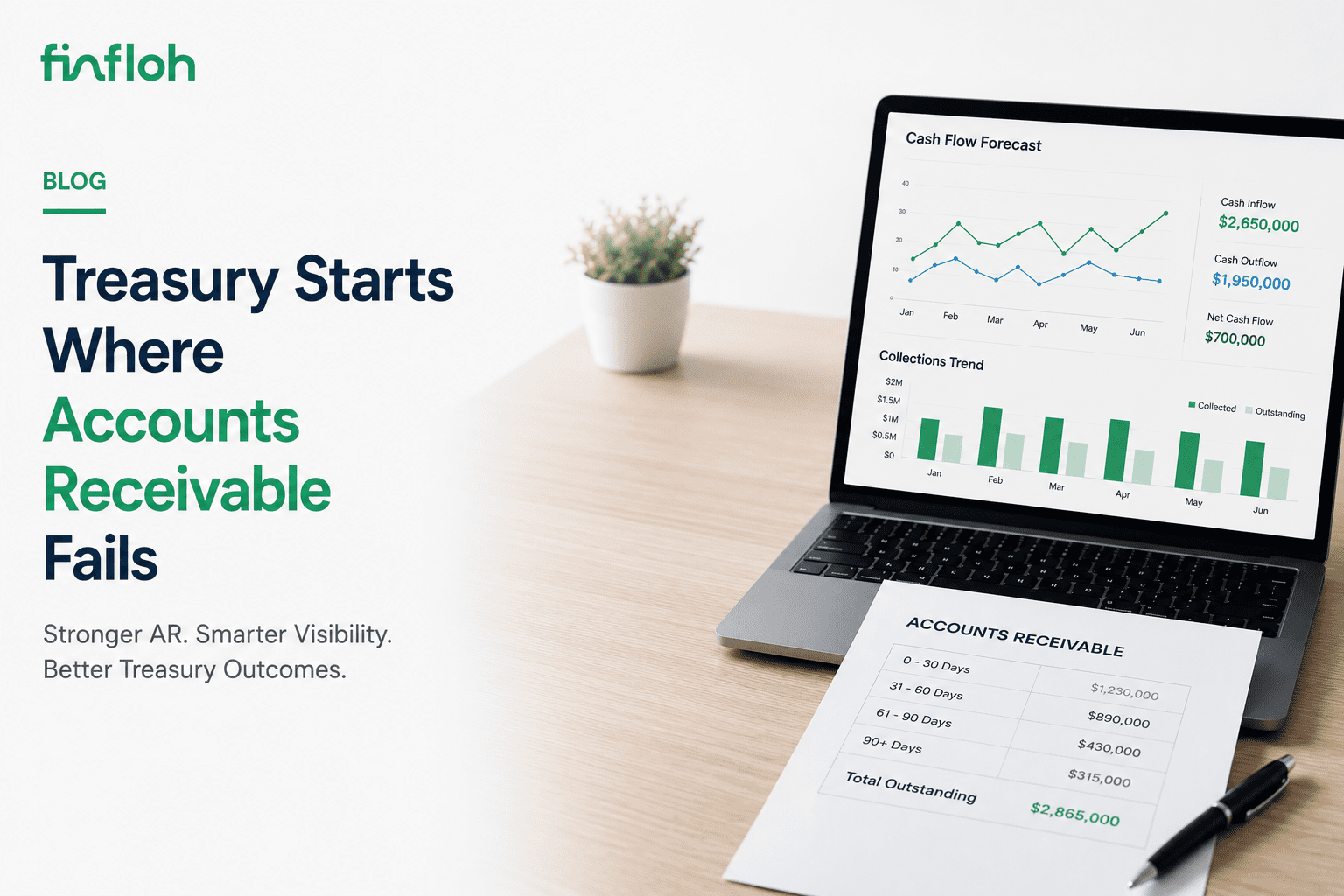

For many organizations, treasury and accounts receivable (AR) operate as separate finance functions with different priorities. Treasury focuses on liquidity, cash positioning, funding, and financial risk management, while AR teams manage invoicing, collections, disputes, and cash application.
But in reality, treasury outcomes are heavily shaped by the effectiveness of accounts receivable operations.
When AR processes break down—through delayed collections, inaccurate forecasting, unresolved disputes, or poor payment visibility—the impact ultimately lands on treasury. Cash shortages, borrowing needs, liquidity uncertainty, and forecasting gaps often begin long before treasury teams see the problem.
In many businesses, treasury starts where accounts receivable fails.
Table of Contents
The Hidden Link Between AR and Treasury
Treasury depends on predictable cash inflows to:
- Manage liquidity
- Optimize working capital
- Plan investments
- Meet operational obligations
- Reduce borrowing costs
- Forecast short-term and long-term cash positions
However, treasury forecasts are only as reliable as the receivables data behind them.
When AR visibility is weak, treasury teams are forced to operate with uncertainty.
How AR Problems Become Treasury Problems
Delayed Collections Create Liquidity Pressure
Unpaid invoices directly reduce available working capital.
When collections slow down:
- Treasury teams may rely on short-term borrowing
- Cash reserves become strained
- Payment scheduling becomes difficult
The result is higher financing costs and lower financial flexibility.
Poor Invoice Visibility Weakens Forecasting
Treasury teams need accurate visibility into:
- Expected collections
- Payment delays
- Customer payment behavior
- Outstanding disputes
Without this information, cash forecasts become unreliable.
Disputes Delay Revenue Realization
Unresolved disputes often lock up significant receivable balances.
Treasury may forecast incoming cash that never arrives on time because:
- Deductions remain unresolved
- Invoices are under review
- Documentation is incomplete
Manual Processes Reduce Cash Predictability
Email-driven collections and spreadsheet-based tracking create fragmented data and inconsistent reporting.
Treasury teams struggle to trust cash flow projections when AR processes are highly manual.
Unapplied Cash Distorts Financial Visibility
When payments are received but not accurately matched to invoices:
- Receivables remain open incorrectly
- Customer balances appear inaccurate
- Forecasting becomes distorted
Treasury decisions based on incomplete data increase operational risk.

Why Treasury Teams Are Paying More Attention to AR
Modern treasury management is increasingly moving beyond banking and funding activities.
Treasury leaders are now focused on:
- Real-time liquidity visibility
- Predictive cash forecasting
- Working capital optimization
- Cross-functional finance integration
To achieve these goals, treasury must gain deeper visibility into accounts receivable operations.
The Cost of Poor AR on Treasury Operations
Increased Borrowing Costs
Delayed collections force businesses to depend more heavily on:
- Credit lines
- Working capital loans
- Short-term financing
Idle Cash Management Challenges
Inaccurate forecasts make it difficult to optimize surplus cash allocation.
Reduced Investment Flexibility
Treasury teams cannot confidently allocate capital when cash inflows are uncertain.
Operational Risk Exposure
Unexpected payment delays create downstream risks across:
- Payroll
- Vendor payments
- Debt obligations
- Expansion planning
Treasury Needs More Than Historical AR Data
Traditional AR reporting is often backward-looking.
Treasury teams require:
- Real-time receivables visibility
- Payment behavior insights
- Predictive collection trends
- Dispute risk indicators
- Customer payment forecasting
This shift is driving closer alignment between treasury and AR functions.
The Rise of Integrated Invoice-to-Cash Visibility
Modern finance organizations are moving toward integrated invoice-to-cash ecosystems where treasury and AR operate with shared visibility.
This includes:
- Real-time invoice tracking
- Collections forecasting
- Payment trend analysis
- Automated cash application
- Dispute visibility
- AI-driven receivables insights
How AI Is Transforming AR and Treasury Alignment
AI is helping finance teams improve cash predictability and treasury planning.
Predictive Collections Forecasting
AI models analyze:
- Historical payment patterns
- Customer behavior
- Invoice aging
- Dispute trends
to forecast expected collections more accurately.
Intelligent Risk Detection
Systems identify customers likely to delay payments or create disputes.
Automated Cash Application
Faster reconciliation improves real-time cash visibility.
Dynamic Cash Flow Forecasting
Treasury teams gain continuously updated forecasts based on live AR activity.
Why CFOs Are Connecting Treasury and AR
Finance leaders increasingly recognize that treasury optimization cannot happen independently from receivables performance.
Improving treasury outcomes now requires:
- Faster collections
- Better dispute resolution
- Stronger payment visibility
- Automated reconciliation
- Predictive receivables intelligence
The focus is shifting from reactive cash management to proactive cash orchestration.
How FinFloh Helps Bridge AR and Treasury Visibility
FinFloh helps finance teams improve invoice-to-cash visibility through intelligent AR workflows and real-time receivables insights.
Real-Time Receivables Visibility
Finance and treasury teams gain visibility into:
- Outstanding invoices
- Collection trends
- Customer payment behavior
- Aging and overdue balances
Better Collections Forecasting
Predictive insights improve cash flow planning and liquidity forecasting.
Faster Dispute Resolution
Structured workflows reduce delays caused by deductions and invoice disputes.
Improved Cash Application
Automated reconciliation helps ensure accurate and timely cash visibility.
Unified Invoice-to-Cash Workflows
FinFloh connects invoicing, collections, disputes, and payment visibility in a centralized workflow environment.
To understand how accounts receivable processes can aid treasure operations , you can check out FinFloh A/R product page. You can also Book a Demo to see how it works.
Treasury Transformation Requires AR Transformation
Many treasury challenges are not treasury problems at all—they originate upstream in accounts receivable.
Without strong AR operations:
- Cash forecasting remains unreliable
- Liquidity planning becomes reactive
- Borrowing costs increase
- Working capital optimization becomes difficult
Improving treasury performance requires fixing the operational inefficiencies that delay and distort receivables.
Best Practices for Aligning Treasury and AR
Build Shared Visibility
Treasury and AR teams should operate from unified receivables and cash flow data.
Automate Manual Processes
Reduce dependency on spreadsheets and disconnected workflows.
Improve Forecast Accuracy
Use predictive analytics and real-time payment insights.
Monitor Leading Indicators
Track:
- Collection trends
- Payment delays
- Dispute aging
- Customer risk signals
Integrate Invoice-to-Cash Workflows
Connect invoicing, collections, disputes, and reconciliation into one ecosystem.
Conclusion
Treasury performance is deeply connected to the health of accounts receivable operations.
When AR processes fail—through delayed collections, disputes, poor visibility, or inaccurate reconciliation—treasury absorbs the impact through liquidity pressure and forecasting uncertainty.
As businesses modernize finance operations, the relationship between treasury and AR is becoming more strategic than ever.
Organizations that improve receivables visibility, automate invoice-to-cash workflows, and strengthen collections intelligence will build not only better AR operations—but stronger treasury performance and healthier cash flow foundations overall.

