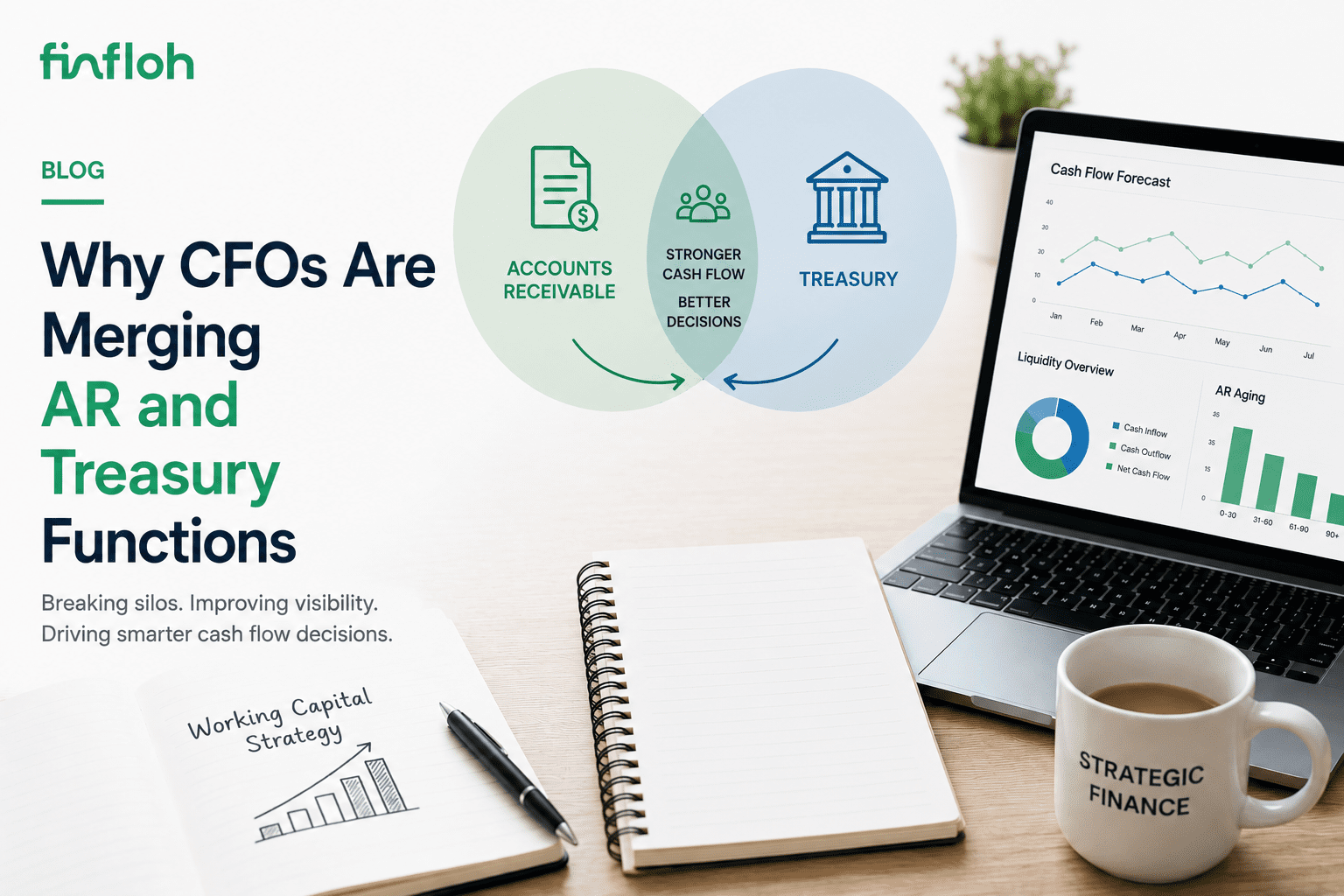

Finance organizations are undergoing a major structural shift. Traditionally, accounts receivable (AR) and treasury teams operated independently with different goals, systems, and workflows. AR focused on invoicing and collections, while treasury managed liquidity, banking, forecasting, and cash positioning.
But as businesses face increasing pressure to improve cash flow visibility, optimize working capital, and forecast liquidity more accurately, CFOs are beginning to merge AR and treasury functions more closely than ever before.
The reason is simple: treasury performance depends heavily on the quality and predictability of accounts receivable operations.
Modern CFOs no longer view AR as just a collections function. They see it as a core driver of liquidity strategy and treasury performance.
Table of Contents
Why the Traditional Separation No Longer Works
In many organizations, AR and treasury still operate in silos:
- Separate systems
- Separate reporting structures
- Different KPIs
- Limited data sharing
This creates operational gaps that impact:
- Cash forecasting
- Liquidity planning
- Working capital optimization
- Payment visibility
Treasury teams often rely on historical or incomplete receivables data, while AR teams operate without understanding broader liquidity priorities.
As finance operations become more data-driven, this separation is becoming increasingly inefficient.
The Growing Pressure on CFOs
Today’s CFOs are expected to:
- Improve working capital
- Reduce borrowing costs
- Increase forecast accuracy
- Improve cash conversion cycles
- Drive operational efficiency
- Support business growth
Achieving these goals requires real-time visibility into expected cash inflows—not just historical reporting.
This is why CFOs are pushing for tighter integration between AR and treasury.

How AR Directly Impacts Treasury
Collections Drive Liquidity
Treasury depends on incoming cash from receivables to manage:
- Daily cash positions
- Vendor payments
- Payroll obligations
- Investments
- Debt servicing
When collections are delayed, treasury operations become reactive.
Forecast Accuracy Depends on AR Visibility
Treasury forecasts rely heavily on:
- Invoice aging
- Customer payment behavior
- Collection timelines
- Dispute status
- Payment commitments
Without accurate AR data, liquidity forecasting becomes unreliable.
Disputes Affect Cash Realization
Open disputes can lock up significant receivable balances and delay expected inflows.
Treasury teams may forecast cash that is not actually collectible within the expected timeframe.
Unapplied Cash Distorts Reporting
When payments are not reconciled quickly:
- Customer balances become inaccurate
- Open receivables appear overstated
- Forecasting confidence decreases
Why CFOs Are Bringing AR and Treasury Closer Together
1. Real-Time Cash Visibility
Modern CFOs want real-time visibility into:
- Outstanding receivables
- Collection forecasts
- Payment risks
- Customer behavior
- Liquidity exposure
Integrating AR and treasury enables a more accurate view of future cash positions.
2. Better Working Capital Management
AR is one of the largest components of working capital.
By aligning treasury and AR operations, businesses can:
- Accelerate collections
- Reduce DSO
- Improve cash conversion cycles
- Optimize liquidity utilization
3. More Accurate Cash Forecasting
Static treasury forecasting models are no longer sufficient.
Integrated AR and treasury workflows allow forecasting models to incorporate:
- Live payment activity
- Customer payment trends
- Promise-to-pay data
- Dispute aging
- Collection effectiveness
4. Reduced Borrowing Dependency
Improved collections visibility helps treasury teams reduce reliance on:
- Credit facilities
- Working capital loans
- Emergency liquidity management
5. Stronger Risk Management
AR data provides early warning signals related to:
- Customer payment deterioration
- Credit risk
- Cash flow disruptions
Treasury teams can use these insights proactively.
Technology Is Accelerating the Shift
Modern finance technology is making AR and treasury convergence easier.
Organizations are increasingly adopting:
- Real-time receivables visibility
- AI-driven cash forecasting
- Integrated invoice-to-cash platforms
- Automated reconciliation
- Predictive collections analytics
These technologies allow finance teams to operate from a unified source of truth.
The Role of AI in AR and Treasury Convergence
AI is helping CFOs connect operational AR data with strategic treasury planning.
Predictive Collections Forecasting
AI models forecast expected collections based on:
- Historical payment behavior
- Invoice patterns
- Customer risk indicators
- Collection trends
Dynamic Cash Flow Forecasting
Treasury forecasts automatically adjust based on real-time AR activity.
Intelligent Risk Detection
AI identifies customers likely to:
- Delay payments
- Raise disputes
- Create cash flow risk
Automated Cash Application
Faster reconciliation improves treasury visibility into actual cash positions.
Organizational Changes Driving Integration
Many finance leaders are also changing organizational structures.
Some businesses are:
- Creating unified invoice-to-cash teams
- Aligning treasury and AR KPIs
- Centralizing working capital functions
- Building shared reporting environments
The focus is shifting from isolated finance functions to connected cash flow management.
Common Challenges in AR and Treasury Alignment
Disconnected Systems
ERP, banking, collections, and forecasting systems often operate independently.
Inconsistent Data
Manual spreadsheets and fragmented reporting reduce forecasting accuracy.
Lack of Shared KPIs
AR teams may focus on collections volume while treasury focuses on liquidity positioning.
Limited Real-Time Visibility
Delayed reporting prevents proactive decision-making.
How FinFloh Helps Connect AR and Treasury Visibility
FinFloh helps finance teams improve invoice-to-cash visibility through integrated AR workflows and real-time receivables insights.
Real-Time Receivables Visibility
Treasury and finance teams gain visibility into:
- Invoice aging
- Collection activity
- Payment trends
- Customer payment behavior
Improved Collections Forecasting
Predictive insights help improve short-term and long-term liquidity planning.
Faster Reconciliation
Automated cash application improves accuracy and real-time cash visibility.
Better Dispute Tracking
Structured workflows help reduce delays caused by unresolved deductions and disputes.
Unified Invoice-to-Cash Workflows
FinFloh connects invoicing, collections, disputes, and pa yment tracking into a centralized workflow environment.
The Future of Finance Is Connected
The traditional separation between treasury and accounts receivable is gradually disappearing.
Modern finance organizations are moving toward:
- Unified cash visibility
- Integrated invoice-to-cash operations
- AI-driven forecasting
- Collaborative working capital management
CFOs increasingly recognize that treasury outcomes begin upstream in receivables performance.
Best Practices for CFOs Merging AR and Treasury
Create Shared Visibility
Ensure treasury and AR teams work from unified receivables data.
Align KPIs
Measure both teams against shared working capital and cash flow objectives.
Automate Manual Processes
Reduce dependency on spreadsheets and disconnected workflows.
Invest in Predictive Analytics
Use AI-driven forecasting and payment intelligence.
Integrate Invoice-to-Cash Systems
Connect invoicing, collections, disputes, reconciliation, and forecasting into one ecosystem.
Conclusion
CFOs are increasingly merging AR and treasury functions because cash flow management can no longer operate in silos.
Treasury performance depends on the accuracy, visibility, and predictability of receivables operations. Delayed collections, disputes, poor reconciliation, and fragmented workflows directly impact liquidity planning and financial agility.
By aligning AR and treasury more closely, businesses can improve forecasting accuracy, optimize working capital, reduce financial risk, and create a more connected finance organization.
As finance transformation accelerates, the future belongs to organizations that treat receivables and treasury as part of one continuous cash flow strategy.

